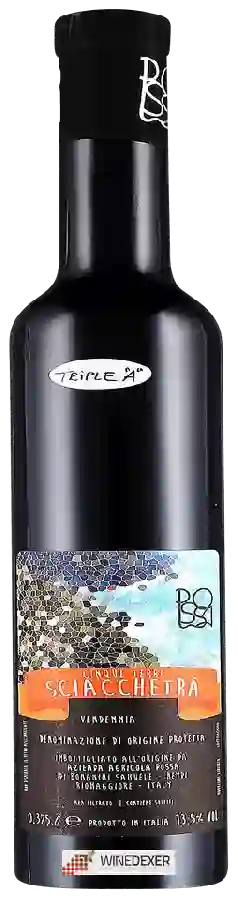
Winery PossaCinque Terre Sciacchetrà
 Sweet wine


This wine generally goes well with

Wine flavors and olphactive analysis

On the nose the Cinque Terre Sciacchetrà of Winery Possa in the region of Liguria often reveals types of flavors of earth.
Details and technical informations about Winery Possa's Cinque Terre Sciacchetrà.
Discover the grape variety: Isabelle
Simple whites and reds with the characteristic foxy taste of Vitis labrusca (wild strawberry, wild raspberry), a supple palate with moderate acidity, and a rustic profile marked by labruscoid notes. In France, one of the six prohibited hybrids since 1935 (along with Clinton, Herbemont, Jacquez, Noah, Othello). Still found in heritage trellises and in some countries (Brazil, Georgia). American hybrid derived from Vitis labrusca, imported to Europe in the 19th century.
Last vintages of this wine
The best vintages of Cinque Terre Sciacchetrà from Winery Possa are 2016, 2017, 2015, 2013 and 0.
Informations about the Winery Possa
The Winery Possa is one of of the world's greatest estates. It offers 12 wines for sale in the of Cinque Terre to come and discover on site or to buy online.

The wine region of Cinque Terre
Ligurian mythical DOC between Levanto and La Spezia, UNESCO terraced vineyards overlooking the sea, heroic viticulture by monorails. Bosco, Albarola and Vermentino signature whites: dry and saline with citrus, green apple, white flowers, Mediterranean herbs and iodic mineral touch, taut thirst-quenching palate. Mythical version Sciacchetrà passito (grapes dried >70 days): golden to amber, honey, dried apricot, marine salinity — rare great Italian liqueur.
The wine region of Liguria
Coastal region of northwest Italy on the Riviera, terraced vineyards among the steepest in Europe (~1,650 ha). Vermentino signature in white: fresh and saline with signature notes of citrus, white flowers, wild herbs, fresh almond and an iodine mineral touch, taut long mouth. Local Pigato similar and ample, mineral Bosco (min. 40% in Cinque Terre), Albarola.
The word of the wine: Rootstock
American vine on which a French vine is grafted. This is the consequence of the phylloxera that destroyed the vineyard at the end of the 19th century: after much trial and error, it was discovered that the "pest" spared the roots of the American vines, and the technique became widespread.