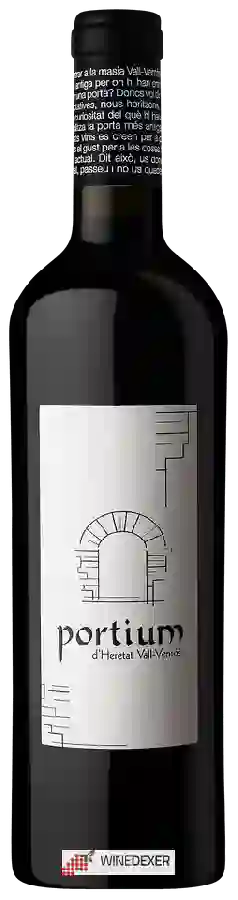
Winery PortiumTinto
 Red wine


This wine is a blend of 2 varietals which are the Cabernet-Sauvignon and the Merlot.
In the mouth this red wine is a powerful.
This wine generally goes well with poultry, beef or veal.
Taste structure of the Tinto from the Winery Portium
Light | Bold | |
Smooth | Tannic | |
Dry | Sweet | |
Soft | Acidic |
In the mouth the Tinto of Winery Portium in the region of Catalogne is a powerful.
Food and wine pairings with Tinto
Pairings that work perfectly with Tinto



Original food and wine pairings with Tinto

The Tinto of Winery Portium matches generally quite well with dishes of beef, pasta or veal such as recipes of cabri en colombo with creole sauce, chinese noodles with vegetables and spices or stuffed veal breast.
Details and technical informations about Winery Portium's Tinto.
Discover the grape variety: Cabernet-Sauvignon
Cabernet-Sauvignon noir is a grape variety that originated in France (Bordeaux). It produces a variety of grape specially used for wine making. It is rare to find this grape to eat on our tables. This variety of grape is characterized by small bunches, and small grapes. Cabernet-Sauvignon noir can be found in many vineyards: South-West, Loire Valley, Languedoc & Roussillon, Cognac, Bordeaux, Armagnac, Rhone Valley, Provence & Corsica, Savoie & Bugey, Beaujolais.
Last vintages of this wine

The best vintages of Tinto from Winery Portium are 2019, 2014, 0, 2015 and 2017.
Informations about the Winery Portium
The Winery Portium is one of of the world's greatest estates. It offers 7 wines for sale in the of Catalogne to come and discover on site or to buy online.

The wine region of Catalogne
Catalonia (Catalunya in Catalan and Cataluña in Spanish) is an autonomous community in the Northeast of Spain. It extends from the historic county (comarca) of Montsia in the South to the border with France in the north. The Mediterranean Sea forms its eastern border and offers 580 km of coastline. The Catalunya D.
The word of the wine: Clone
A vine propagated from a single specimen (by cuttings or grafting), as opposed to mass selection, which starts from a family of vines.