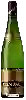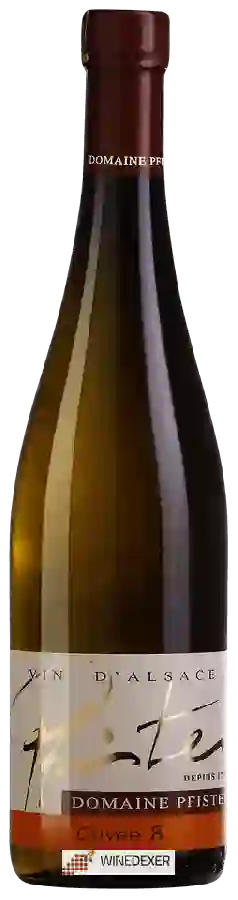
Domaine PfisterCuvée 8
 White wine


This wine is a blend of 4 varietals which are the Gewurztraminer, the Muscat Ottonel, the Pinot gris and the Riesling.
This wine generally goes well with pork, vegetarian or poultry.

Wine flavors and olphactive analysis

Food and wine pairings with Cuvée 8
Pairings that work perfectly with Cuvée 8



Original food and wine pairings with Cuvée 8



The Cuvée 8 of Domaine Pfister matches generally quite well with dishes of pork, rich fish (salmon, tuna etc) or shellfish such as recipes of andouillette with mustard sauce, sea bream fillets with capers or pasta with mussels.
Details and technical informations about Domaine Pfister's Cuvée 8.
Discover the grape variety: Gewurztraminer
Full-bodied, exotic whites, rich and heady, with moderate acidity, showing opulent aromas of lychee, rose, mango, ginger, pink grapefruit and gentle spice. Made as aromatic dry, moelleux late-harvest and liquorous sélection de grains nobles. Star of Alsace AOC (one of the four noble varieties) and signature of Alto Adige (Tramin), Palatinate and Germany. A pink mutation of Traminer.
Last vintages of this wine

The best vintages of Cuvée 8 from Domaine Pfister are 2011, 2015, 2014, 2013 and 2012.
Informations about the Domaine Pfister
The Domaine Pfister is one of of the world's greatest estates. It offers 48 wines for sale in the of Alsace to come and discover on site or to buy online.

The wine region of Alsace
Capital of great French aromatic whites, most often dry and single-varietal. Straight, mineral Riesling (lemon, gunflint), opulent, exuberant Gewurztraminer (lychee, rose, spices), round, smoky Pinot Gris, floral, crisp Muscat, supple Pinot Blanc. Fine, fruity Crémants d'Alsace, exceptional sweet Vendanges Tardives and Sélection de Grains Nobles. 15,500 ha at the foot of the Vosges on varied soils, 51 Grands Crus since 1975.
The word of the wine: Rehoboam
Bottle with a capacity of 4.5 l.