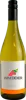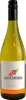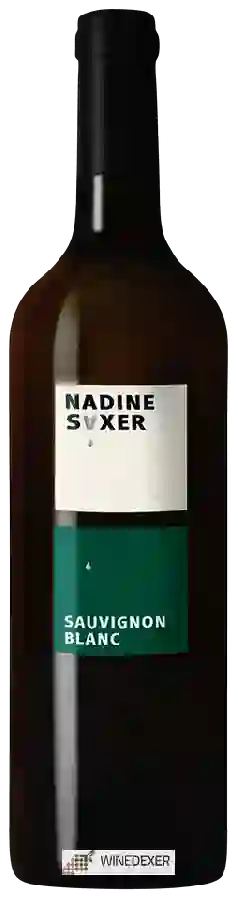
Winery Nadine SaxerSauvignon Blanc
 White wine


This wine generally goes well with vegetarian, rich fish (salmon, tuna etc) or shellfish.
The Sauvignon Blanc of the Winery Nadine Saxer is in the top 80 of wines of Switzerland and in the top 5 of wines of Schaffhausen.

Wine flavors and olphactive analysis




On the nose the Sauvignon Blanc of Winery Nadine Saxer in the region of Schaffhausen often reveals types of flavors of earth, vegetal or oak and sometimes also flavors of tree fruit, citrus fruit or black fruit.
Food and wine pairings with Sauvignon Blanc
Pairings that work perfectly with Sauvignon Blanc



Original food and wine pairings with Sauvignon Blanc
The Sauvignon Blanc of Winery Nadine Saxer matches generally quite well with dishes of rich fish (salmon, tuna etc), shellfish or vegetarian such as recipes of hawaiian poke bowl, chinese fondue or tuna, pepper and tomato quiche.
Details and technical informations about Winery Nadine Saxer's Sauvignon Blanc.
Discover the grape variety: Carmenère
Velvety, deep reds with a dark robe and round tannins, showing aromas of blackberry, plum, ripe red pepper, dark chocolate, coffee and gentle spice. Warm, supple finish. Absolute star of Chile (Colchagua, Cachapoal, Maipo) where it was rediscovered in 1994, long confused with Merlot. A historic Bordeaux variety that nearly vanished after phylloxera, a cross of Cabernet Franc × Gros Cabernet.
Last vintages of this wine
The best vintages of Sauvignon Blanc from Winery Nadine Saxer are 2020, 2019, 2017, 2015 and 2018.
Informations about the Winery Nadine Saxer
The Winery Nadine Saxer is one of of the world's greatest estates. It offers 20 wines for sale in the of Schaffhausen to come and discover on site or to buy online.

The wine region of Schaffhausen
Wine canton of northern German-speaking Switzerland, nicknamed "Blauburgunderland". Signature Pinot Noir (Blauburgunder, 60-70%): fine, silky reds with signature notes of cherry, raspberry, undergrowth, sweet spices and a chalky mineral touch, delicate tannins and taut freshness — compared to fine village Burgundies. Klettgau is the flagship sub-region. Müller-Thurgau whites (local Riesling-Silvaner) lively and fruity (apple, citrus).
The word of the wine: Biodynamic (agriculture)
Organic agriculture is part of a vision of the world linking the plant and all living beings to the cosmos and basing work in the vineyard and the cellar on the cycles of the moon.