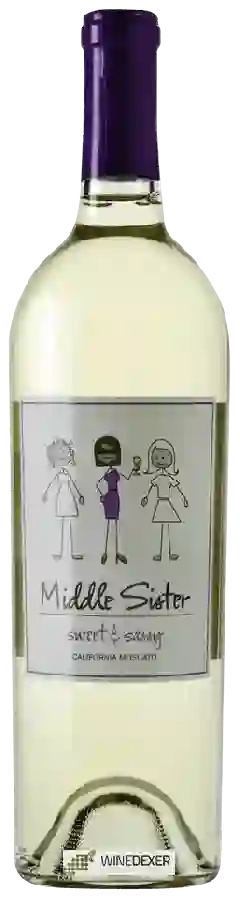
Winery Middle SisterSweet & Sassy Moscato
 Sweet wine



This wine generally goes well with sweet desserts
Wine flavors and olphactive analysis






On the nose the Sweet & Sassy Moscato of Winery Middle Sister in the region of Mendoza often reveals types of flavors of earth, microbio or oak and sometimes also flavors of tree fruit, citrus fruit or floral.
Food and wine pairings with Sweet & Sassy Moscato
Pairings that work perfectly with Sweet & Sassy Moscato

Original food and wine pairings with Sweet & Sassy Moscato
The Sweet & Sassy Moscato of Winery Middle Sister matches generally quite well with dishes of sweet desserts such as recipes of express cherry clafoutis.
Details and technical informations about Winery Middle Sister's Sweet & Sassy Moscato.
Discover the grape variety: Regent
A complex interspecific cross between the diana (sylvaner x Müller-Thurgau) and the chambourcin obtained in Germany in 1967 by Gerhardt Alleweldt. It can be found in Quebec (Canada), Belgium and Switzerland, but is little known in France. It should be noted that Regent, a monogenic variety, which is nevertheless resistant to certain cryptogamic diseases, was "bypassed" in 2010 by a less resistant strain of mildew, which was also the case for bianca.
Last vintages of this wine
The best vintages of Sweet & Sassy Moscato from Winery Middle Sister are 2015, 2014, 0, 2012 and 2013.
Informations about the Winery Middle Sister
The Winery Middle Sister is one of of the world's greatest estates. It offers 15 wines for sale in the of Mendoza to come and discover on site or to buy online.

The wine region of Mendoza
Mendoza is by far the largest wine region in Argentina. Located on a high-altitude plateau at the edge of the Andes Mountains, the province is responsible for roughly 70 percent of the country's annual wine production. The French Grape variety Malbec has its New World home in the vineyards of Mendoza, producing red wines of great concentration and intensity. The province Lies on the western edge of Argentina, across the Andes Mountains from Chile.
The word of the wine: Body
Character of a wine combining a good constitution (structure and flesh) with warmth.