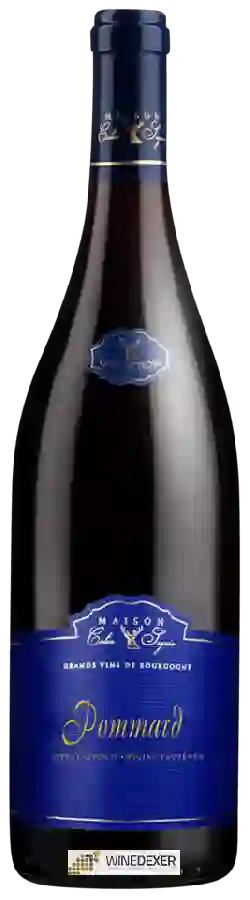
Maison Colin SeguinPommard
 Red wine



In the mouth this red wine is a with a nice freshness.
This wine generally goes well with poultry, beef or veal.
Taste structure of the Pommard from the Maison Colin Seguin
Light | Bold | |
Smooth | Tannic | |
Dry | Sweet | |
Soft | Acidic |
In the mouth the Pommard of Maison Colin Seguin in the region of Burgundy is a with a nice freshness.
Food and wine pairings with Pommard
Pairings that work perfectly with Pommard



Original food and wine pairings with Pommard

The Pommard of Maison Colin Seguin matches generally quite well with dishes of beef, veal or game (deer, venison) such as recipes of tibs (ethiopia), wiener schnitzel or viennese schnitzel or paella valenciana (without seafood).
Details and technical informations about Maison Colin Seguin's Pommard.
Discover the grape variety: Italia Rubi
Pink selection made in Brazil, following a natural coloured mutation of the italia, discovered in 1981 by San Giorgio Jonico. Since 24.08.2009, it is registered in the Official Catalogue of table grape varieties, list A1. In Italy, a more colourful mutation of the Rubi was discovered, called benitaka, which is more uniform in berry colour and ripens about a week earlier. The black brasil variety, which can be found in Brazil, is said to be a natural mutation of benitaka. Finally, Rubi should not be confused with ruby seedless, also a pink apyrene grape.
Informations about the Maison Colin Seguin
The Maison Colin Seguin is one of of the world's great estates. It offers 188 wines for sale in the of Pommard to come and discover on site or to buy online.

The wine region of Pommard
The wine region of Pommard is located in the region of Côte de Beaune of Burgundy of France. Wineries and vineyards like the Domaine Leroy or the Château de Pommard produce mainly wines red. The most planted grape varieties in the region of Pommard are Pinot noir, Cabernet-Sauvignon and Gamay noir, they are then used in wines in blends or as a single variety. On the nose of Pommard often reveals types of flavors of cherry, truffle or clove and sometimes also flavors of game, cheese or rose petal.
The wine region of Burgundy
Bourgogne is the catch-all regional appellation title of the Burgundy wine region in eastern France ("Bourgogne" is the French name for Burgundy). Burgundy has a Complex and comprehensive appellation system; counting Premier Cru and Grand Cru titles, the region has over 700 appellation titles for its wines. Thus, Burgundy wines often come from one Vineyard (or several separate vineyards) without an appellation title specific to the region, Village or even vineyard. A standard Burgundy wine may be made from grapes grown in one or more of Burgundy's 300 communes.
The word of the wine: Premier cru
In Burgundy, third level of classification (above the regional and communal appellations), designating the wines produced on delimited parcels (climats) whose name is added to the communal appellation. The climats classified as first growths are 635.