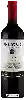
Winery MaberaBarbera
 Red wine
This wine generally goes well with pork, poultry or mild and soft cheese.
Wine flavors and olphactive analysis

Food and wine pairings with Barbera
Pairings that work perfectly with Barbera



Original food and wine pairings with Barbera

The Barbera of Winery Mabera matches generally quite well with dishes of pork, spicy food or poultry such as recipes of stuffed round zucchini, marinated tacaud fillets or caramel chicken.
Details and technical informations about Winery Mabera's Barbera.
Discover the grape variety: Cornalin d'Aoste
It is a variety of Valle d'Aosta origin and, like Arvine, it is also found in Italy. In the past, it was cultivated in Savoy and registered in the official catalogue of wine grape varieties, list B, under the name of red humagne, but it is not related to white humagne. According to recent genetic analyses, the Swiss variety Cornalin du Valais is its father and Rèze its grandmother. It is also the grandson of the petit rouge d' Aoste.
Informations about the Winery Mabera
The Winery Mabera is one of of the world's greatest estates. It offers 6 wines for sale in the of Sierra Foothills to come and discover on site or to buy online.

The wine region of Sierra Foothills
The wine region of Sierra Foothills is located in the region of California of United States. We currently count 249 estates and châteaux in the of Sierra Foothills, producing 661 different wines in conventional, organic and biodynamic agriculture. The wines of Sierra Foothills go well with generally quite well with dishes .
The wine region of California
California is the largest and most important wine region in the United States. It represents the southern two-thirds (850 miles or 1,370 kilometers) of the country's west coast. (Oregon and Washington make up the rest. ) The state also spans nearly 10 degrees of latitude.
The word of the wine: Deposit
Solid particles that can naturally coat the bottom of a bottle of wine. It is rather a guarantee that the wine has not been mistreated: in fact, to avoid the natural deposit, rather violent processes of filtration or cold passage (- 7 or - 8 °C) are used in order to precipitate the tartar (the small white crystals that some people confuse with crystallized sugar: just taste to dissuade you from it)