The Winery Liebfrauenstift of Rheinhessen
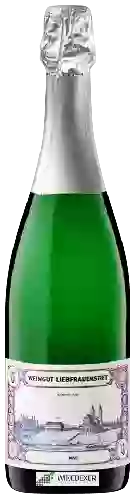
The Winery Liebfrauenstift is one of the best wineries to follow in Rheinhessen.. It offers 8 wines for sale in of Rheinhessen to come and discover on site or to buy online.
Looking for the best Winery Liebfrauenstift wines in Rheinhessen among all the wines in the region? Check out our tops of the best red, white or effervescent Winery Liebfrauenstift wines. Also find some food and wine pairings that may be suitable with the wines from this area. Learn more about the region and the Winery Liebfrauenstift wines with technical and enological descriptions.
How Winery Liebfrauenstift wines pair with each other generally quite well with dishes of pork, rich fish (salmon, tuna etc) or spicy food such as recipes of sauté of pork with cider, chinese fondue or beef fajitas.
Rheinhessen is Germany's largest region for producing the quality wines of the Qualitätswein bestimmter Anbaugebiete (QbA) and Prädikatswein designations, with roughly 26,500 hectares (65,000 acres) of Vineyard">Vineyards as of 2014. Many of its most significant viticultural areas are favorably influenced by the Rhine river, which runs aLong its North and eastern borders. The Rhine, along with the Nahe river to the west and the Haardt mountains to its South, form a natural border. Rheinhessen covers an area south of Rheingau, north of Pfalz and east of Nahe, and is located within the Rhineland-Palatinate federal state.
The region has been cultivating Grapes for wine production at least since ancient Roman occupation. It's also the home to the oldest surviving records of a German vineyard. Named Glöck, the vineyard was included in a deed for a church and vineyards gifted by Carloman – a duke of the Franks of the Carolingian family and the uncle of the first Holy Roman Emperor, Charlemagne – to the diocese of Würzburg in 742. Within a century, dozens of villages were cultivating grapes throughout Rheinhessen.
An early documentation of Riesling as a distinct grape variety, identified as Rüssling, was also found in records from the city Worms dating back to 1402. The Size of the region, and its location on the Rhine, has given it a significant role in Germany's wine industry history. Its largest city, Mainz, has been an unofficial Center for wine trade, being home to several national wine organizations including the German Wine Institute and the Association of German Prädikat Wine Estates (Verband Deutscher Prädikats-und Qualitätsweingüter e. V.
How Winery Liebfrauenstift wines pair with each other generally quite well with dishes of pork, shellfish or spicy food such as recipes of delicious marinated pork chops, marinated mussels with maroilles or chicken with maroilles.
On the nose the white wine of Winery Liebfrauenstift. often reveals types of flavors of earth, tree fruit or citrus fruit. In the mouth the white wine of Winery Liebfrauenstift. is a with a nice freshness.
White Riesling is a grape variety that originated in France (Alsace). It produces a variety of grape specially used for the elaboration of wine. It is rare to find this grape to eat on our tables. This variety of grape is characterized by small bunches, and small grapes. White Riesling can be found in many vineyards: Alsace, Loire Valley, Languedoc & Roussillon, Lorraine, Provence & Corsica, Rhone Valley, Savoie & Bugey, Beaujolais, South West.
Planning a wine route in the of Rheinhessen? Here are the wineries to visit and the winemakers to meet during your trip in search of wines similar to Winery Liebfrauenstift.
Colombard is one of the oldest grape varieties in the Charentes. This golden white grape variety is a cross between Chenin and Gouais. The young leaves of colombard are yellow with bronze patches. The adult leaves may be three-lobed or whole, depending on the variety. Its branches are cottony. The bunches of this variety are thick and cylindrical. Its elliptical berries are medium-sized. They change color until they ripen, ranging from greenish white to golden yellow. Colombard is associated with an average budding. It is particularly susceptible to leafhoppers, grape worms, mites, mildew, powdery mildew and gray mold. It is also sensitive to water stress, but is not very sensitive to wind. It ripens late in the second half of the year. There are a dozen approved clones of Colombard, the best known of which are 608, 607 and 606. This variety produces a full-bodied, fine white wine. Aromas of lime, nectarine, boxwood, citrus and exotic fruits are released.