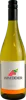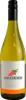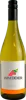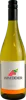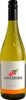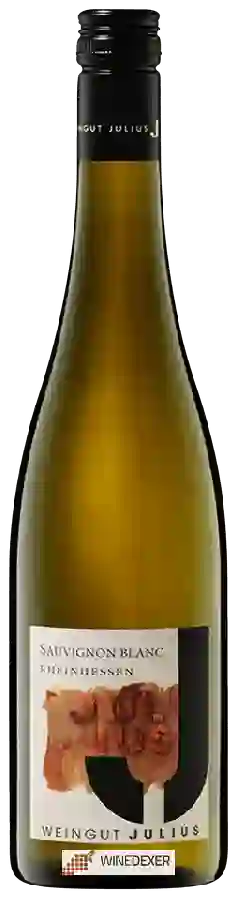
Winery JuliusSauvignon Blanc
 White wine



In the mouth this white wine is a with a nice freshness.
This wine generally goes well with vegetarian, shellfish or goat cheese.
Taste structure of the Sauvignon Blanc from the Winery Julius
Light | Bold | |
Dry | Sweet | |
Soft | Acidic |
In the mouth the Sauvignon Blanc of Winery Julius in the region of Rheinhessen is a with a nice freshness.
Wine flavors and olphactive analysis


On the nose the Sauvignon Blanc of Winery Julius in the region of Rheinhessen often reveals types of flavors of earth, vegetal or tree fruit and sometimes also flavors of citrus fruit.
Food and wine pairings with Sauvignon Blanc
Pairings that work perfectly with Sauvignon Blanc



Original food and wine pairings with Sauvignon Blanc
The Sauvignon Blanc of Winery Julius matches generally quite well with dishes of shellfish, vegetarian or goat cheese such as recipes of tagliatelle with shrimps, broccoli and blue cheese quiche without pastry or peach and apricot chicken (about 270 calories).
Details and technical informations about Winery Julius's Sauvignon Blanc.
Discover the grape variety: Floreal
A wine grape variety of the INRA-Resdur1 series with polygenic resistance (two genes for mildew and powdery mildew have been identified), resulting from an interspecific cross between Villaris and Mtp 3159-2-12 (for the latter, one of its parents is Vitis rotundifolia, which is resistant to Pierce's disease, mildew, grey rot, etc.). Little multiplied, it is registered in the Official Catalogue of wine grape varieties list A1.
Last vintages of this wine
The best vintages of Sauvignon Blanc from Winery Julius are 2016, 2018, 2017, 0 and 2012.
Informations about the Winery Julius
The Winery Julius is one of of the world's greatest estates. It offers 26 wines for sale in the of Rheinhessen to come and discover on site or to buy online.

The wine region of Rheinhessen
Rheinhessen is Germany's largest region for producing the quality wines of the Qualitätswein bestimmter Anbaugebiete (QbA) and Prädikatswein designations, with roughly 26,500 hectares (65,000 acres) of Vineyard">Vineyards as of 2014. Many of its most significant viticultural areas are favorably influenced by the Rhine river, which runs aLong its North and eastern borders. The Rhine, along with the Nahe river to the west and the Haardt mountains to its South, form a natural border. Rheinhessen covers an area south of Rheingau, north of Pfalz and east of Nahe, and is located within the Rhineland-Palatinate federal state.
The word of the wine: Ladle
Said of a wine that is not clear due to the presence of colloidal suspensions that prevent the passage of light.