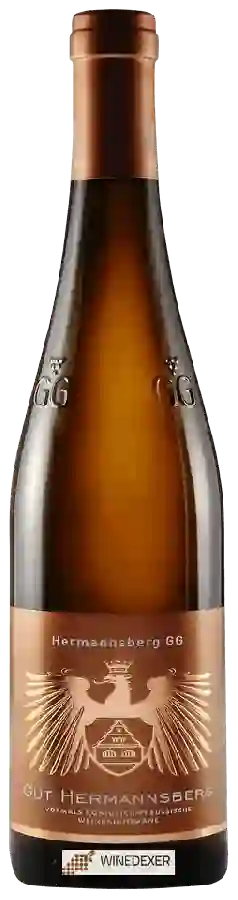
Winery Gut HermannsbergHermannsberg GG
 White wine


In the mouth this white wine is a powerful with a nice freshness.
This wine generally goes well with pork, poultry or shellfish.
The Hermannsberg GG of the Winery Gut Hermannsberg is in the top 20 of wines of Nahe.

Taste structure of the Hermannsberg GG from the Winery Gut Hermannsberg
Light | Bold | |
Dry | Sweet | |
Soft | Acidic |
In the mouth the Hermannsberg GG of Winery Gut Hermannsberg in the region of Nahe is a powerful with a nice freshness.
Wine flavors and olphactive analysis





On the nose the Hermannsberg GG of Winery Gut Hermannsberg in the region of Nahe often reveals types of flavors of non oak, earth or microbio and sometimes also flavors of vegetal, oak or tree fruit.
Food and wine pairings with Hermannsberg GG
Pairings that work perfectly with Hermannsberg GG



Original food and wine pairings with Hermannsberg GG


The Hermannsberg GG of Winery Gut Hermannsberg matches generally quite well with dishes of pork, shellfish or spicy food such as recipes of quiche lorraine, express seafood spaghetti or mussels with curry.
Details and technical informations about Winery Gut Hermannsberg's Hermannsberg GG.
Discover the grape variety: Riesling
Crystalline, taut whites with vibrant acidity and aromas of citrus, green apple, white flowers, vineyard peach and mineral/petrol notes with age. Made as dry (Trocken, Alsace), off-dry (Kabinett, Spätlese) and sweet (Auslese, Beerenauslese, Trockenbeerenauslese, late harvest). Star of the Moselle, Rheingau, Alsace AOC and Wachau. Also exported to Clare Valley and Finger Lakes.
Last vintages of this wine

The best vintages of Hermannsberg GG from Winery Gut Hermannsberg are 2018, 2011, 2016, 2015 and 2014.
Informations about the Winery Gut Hermannsberg
The Winery Gut Hermannsberg is one of of the world's greatest estates. It offers 52 wines for sale in the of Nahe to come and discover on site or to buy online.

The wine region of Nahe
Homeland of a mineral Riesling of exceptional geological expression: lively, precise whites with notes of peach, citrus, green apple, gunflint and fine salinity, from taut dry to botrytised sweet. 75% whites, Riesling king (27%) complemented by round Pinot Gris and supple Pinot Blanc. Rising reds: silky Spätburgunder with red fruit, darker Dornfelder. 4,240 ha along the Nahe river, among the most diverse soils in Germany (180 formations).
The word of the wine: Flavours
There are generally four so-called fundamental flavours: acidity, bitterness, sweetness and saltiness. The first three are considered to be the building blocks of the structure of wines. They are perceived by the taste buds that cover the surface of the tongue.