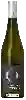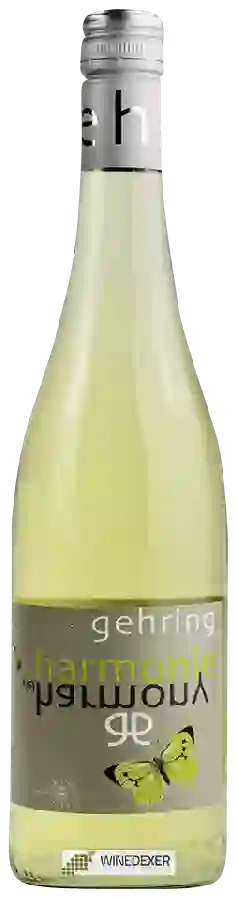
Winery GehringViel Harmonie
 White wine



This wine generally goes well with vegetarian, rich fish (salmon, tuna etc) or shellfish.
Food and wine pairings with Viel Harmonie
Pairings that work perfectly with Viel Harmonie



Original food and wine pairings with Viel Harmonie
The Viel Harmonie of Winery Gehring matches generally quite well with dishes of rich fish (salmon, tuna etc), shellfish or vegetarian such as recipes of cod rougail, rice with seafood or quiche with bacon and gruyère cheese.
Details and technical informations about Winery Gehring's Viel Harmonie.
Discover the grape variety: Gaïdouria
A very old and rare Greek grape variety that is still cultivated to some extent in the Cyclades, particularly in the Santorini archipelago. D.N.A. analyses have shown that it is related to Assyrtiko. On the island of Corfu, a black grape variety called Gaïdouricha is cultivated, but it is not related to Assyrtiko. Gaïdouria can be found in Turkey, but it is unknown in France and in most other wine-producing countries.
Last vintages of this wine
The best vintages of Viel Harmonie from Winery Gehring are 0
Informations about the Winery Gehring
The Winery Gehring is one of of the world's great estates. It offers 40 wines for sale in the of Rheinhessen to come and discover on site or to buy online.

The wine region of Rheinhessen
Rheinhessen is Germany's largest region for producing the quality wines of the Qualitätswein bestimmter Anbaugebiete (QbA) and Prädikatswein designations, with roughly 26,500 hectares (65,000 acres) of Vineyard">Vineyards as of 2014. Many of its most significant viticultural areas are favorably influenced by the Rhine river, which runs aLong its North and eastern borders. The Rhine, along with the Nahe river to the west and the Haardt mountains to its South, form a natural border. Rheinhessen covers an area south of Rheingau, north of Pfalz and east of Nahe, and is located within the Rhineland-Palatinate federal state.
The word of the wine: Oenologist
Specialist in wine-making techniques. It is a profession and not a passion: one can be an oenophile without being an oenologist (and the opposite too!). Formerly attached to the Faculty of Pharmacy, oenology studies have become independent and have their own university course. Learning to make wine requires a good chemical background but also, increasingly, a good knowledge of the plant. Some oenologists work in laboratories (analysis). Others, the consulting oenologists, work directly in the properties.