The Domaine le Renard of Rhône méridional of Rhone Valley
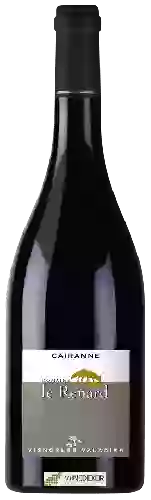
The Domaine le Renard is one of the best wineries to follow in Rhône méridional.. It offers 9 wines for sale in of Rhône méridional to come and discover on site or to buy online.
Looking for the best Domaine le Renard wines in Rhône méridional among all the wines in the region? Check out our tops of the best red, white or effervescent Domaine le Renard wines. Also find some food and wine pairings that may be suitable with the wines from this area. Learn more about the region and the Domaine le Renard wines with technical and enological descriptions.
How Domaine le Renard wines pair with each other generally quite well with dishes of beef, lamb or game (deer, venison) such as recipes of roast pork with pineapple, moroccan style leg of lamb or blanquette of rabbit with riesling and chanterelles.
On the nose the red wine of Domaine le Renard. often reveals types of flavors of cherry, smoke or earthy and sometimes also flavors of blackberry, black cherries or plum. In the mouth the red wine of Domaine le Renard. is a powerful with a nice balance between acidity and tannins.
Côtes du Rhône is a regional appellation in the Rhône Valley in eastern France. It applies to red, rosé and white wines, and includes more than 170 villages. The area follows the course of the Rhône southward for 125 miles (200 km) from Saint-Cyr-sur-le-Rhône to Avignon. A small portion of the wines in the appellation are white wines.
However, the classic Côtes du Rhône wine is a blend of Fruity, medium-weight reds made from Grenache, Syrah and Mourvèdre. The Côtes du Rhône appellation was introduced in November 1937. Its purpose was to give a general title to good quality Rhone wines from the lesser known and less prestigious wine producing areas of the valley. Côtes du Rhône The landscape of the Côtes du Rhône.
How Domaine le Renard wines pair with each other generally quite well with dishes of beef, pork or shellfish such as recipes of dombrés and pig tails, cassoulet of yesteryear or seafood risotto.
Roussane is a white grape variety, planted on an area of more than 700 ha. Originally from Montélimar, it is also found in Savoie, Languedoc and Roussillon, and grows very well in calcareous, poor, stony soil. It prefers to be pruned short. Roussane is also called fromenteau, barbin or bergeron. The young leaves are bubbled with fine down. When adult, they become thicker. It flowers in June and matures in mid-September. The grapes are cylindrical in shape, the berries are small and turn red when ripe, and the wine produced from pure Roussane is of extraordinary quality. It has a delicate aroma reminiscent of coffee, honeysuckle, iris and peony. The taste of this wine improves with age. It is part of the blend of the appellations Vin-de-Savoie, Côtes-du-Vallée du Rhône or Châteauneuf-du-Pape.
How Domaine le Renard wines pair with each other generally quite well with dishes of beef, lamb or game (deer, venison) such as recipes of delicious bourguignon, mathieu's lamb tagine or rabbit with tomato.
Prolonged contact and exchange between the juice and the grape solids, especially the skin. Not to be confused with the time of fermentation, which follows maceration. The juice becomes loaded with colouring matter and tannins, and acquires aromas. For a rosé, the maceration is short so that the colour does not "rise" too much. For white wines too, a "pellicular maceration" can be practised, which allows the wine to acquire more fat.
Planning a wine route in the of Rhône méridional? Here are the wineries to visit and the winemakers to meet during your trip in search of wines similar to Domaine le Renard.
Marsanne is a white grape variety that originated in Montélimar in the Drôme, several centuries ago. Marsanne is also found in Cassis, Savoie, Languedoc-Roussillon and Saint-Péray in the Ardèche, where it produces remarkable sparkling wines. The warm, sunny climate of the Rhone Valley, Languedoc-Roussillon and Provence, as well as the dry, stony soil, are ideal conditions for its development. Its bunches are quite large and provide small, juicy berries that are sensitive to grey rot and strong winds. These two grape varieties complement each other perfectly: together they give light wines with little acidity, aromas of yellow fruit, white fruit and flowers with notes of honey and liquorice. This is for example what the appellations Saint-Péray, Hermitage, Crozes-Hermitage, Saint-Joseph, Côtes-du-Vallée du Rhône, Corbières, or Cassis express... which represent about 700 hectares.