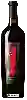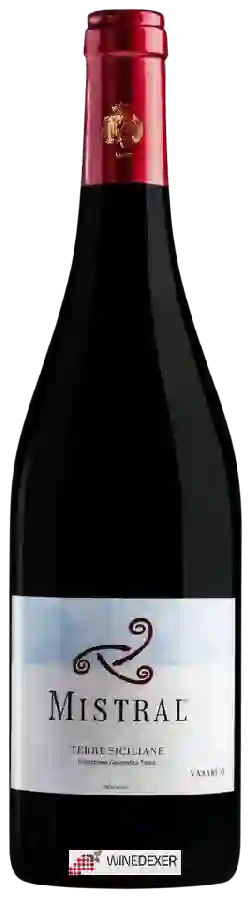
Winery MistralTerre Siciliane
 Red wine



In the mouth this red wine is a powerful.
This wine generally goes well with beef, lamb or pasta.

Taste structure of the Terre Siciliane from the Winery Mistral
Light | Bold | |
Smooth | Tannic | |
Dry | Sweet | |
Soft | Acidic |
In the mouth the Terre Siciliane of Winery Mistral in the region of Sicily is a powerful.
Food and wine pairings with Terre Siciliane
Pairings that work perfectly with Terre Siciliane



Original food and wine pairings with Terre Siciliane
The Terre Siciliane of Winery Mistral matches generally quite well with dishes of beef, pasta or lamb such as recipes of beef stew express, pasta with broccoli or leg of lamb with garlic and rosemary.
Details and technical informations about Winery Mistral's Terre Siciliane.
Discover the grape variety: White muscat
Aromatic, refined whites with a fragrant palate and preserved acidity, showing intense, signature muscat aromas of rose, orange blossom, citrus, exotic fruits (lychee, mango), fresh grape and honey. Made as crisp dry, sparkling (Asti DOCG) and great naturally sweet wines (Beaumes-de-Venise AOC, Muscat de Rivesaltes AOC, Frontignan AOC, Lunel AOC, Samos PDO). Ancient Mediterranean variety, one of the oldest cultivated worldwide, ancestor of many muscats.
Last vintages of this wine
The best vintages of Terre Siciliane from Winery Mistral are 2016
Informations about the Winery Mistral
The Winery Mistral is one of of the world's greatest estates. It offers 3 wines for sale in the of Sicily to come and discover on site or to buy online.

The wine region of Sicily
Major qualitative renewal. Sunny, expressive reds: fleshy, spicy Nero d'Avola (black cherry, blackberry, liquorice), fine, mineral Nerello Mascalese on Etna (recalls Pinot Noir), light, crisp Frappato in Cerasuolo di Vittoria DOCG. Lively, saline whites: Catarratto, fat, iodised Grillo, taut Carricante, floral Inzolia. Amber, walnutty fortified Marsala.
The word of the wine: Alcoholic fermentation
Transformation of sugars into alcohol under the effect of yeast. These yeasts exist in their natural state in the vineyards and in the cellars. Artificial seeding with selected yeasts is however very often practiced.