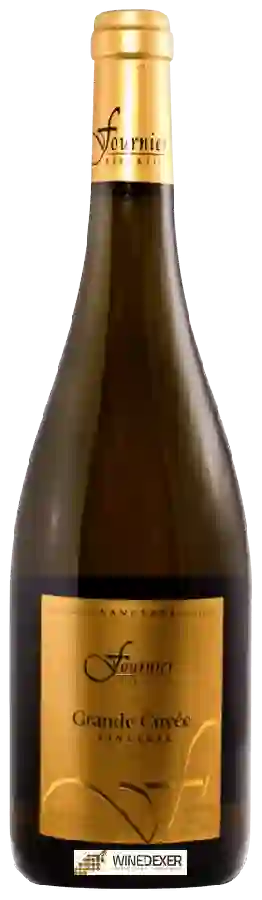
Winery Fournier Pere & FilsGrande Cuvée Sancerre Blanc
 White wine


In the mouth this white wine is a with a nice freshness.
This wine generally goes well with pork, vegetarian or shellfish.
Taste structure of the Grande Cuvée Sancerre Blanc from the Winery Fournier Pere & Fils
Light | Bold | |
Dry | Sweet | |
Soft | Acidic |
In the mouth the Grande Cuvée Sancerre Blanc of Winery Fournier Pere & Fils in the region of Loire Valley is a with a nice freshness.
Wine flavors and olphactive analysis


On the nose the Grande Cuvée Sancerre Blanc of Winery Fournier Pere & Fils in the region of Loire Valley often reveals types of flavors of grapefruit, lemon or pear and sometimes also flavors of vegetal, tree fruit or citrus fruit.
Food and wine pairings with Grande Cuvée Sancerre Blanc
Pairings that work perfectly with Grande Cuvée Sancerre Blanc



Original food and wine pairings with Grande Cuvée Sancerre Blanc


The Grande Cuvée Sancerre Blanc of Winery Fournier Pere & Fils matches generally quite well with dishes of pork, shellfish or spicy food such as recipes of leek, goat cheese and bacon quiche, periwinkles - the perfect cook! or chicken risotto with curry.
Details and technical informations about Winery Fournier Pere & Fils's Grande Cuvée Sancerre Blanc.
Discover the grape variety: Bia blanc
An ancient noble grape variety of the Isère Valley and the Rhône Valley department, which was very present before the phylloxera crisis. In the Saint Marcellin region (Isère), it was often associated with Jacquère and Marsanne. Almost unknown in other French regions and other wine-producing countries, it is in the process of disappearing, although it has been registered since 2011 in the Official Catalogue of wine grape varieties, list A1.
Last vintages of this wine

The best vintages of Grande Cuvée Sancerre Blanc from Winery Fournier Pere & Fils are 2016, 2013, 2009, 2010 and 2012.
Informations about the Winery Fournier Pere & Fils
The Winery Fournier Pere & Fils is one of of the world's great estates. It offers 67 wines for sale in the of Sancerre to come and discover on site or to buy online.

The wine region of Sancerre
The wine region of Sancerre is located in the region of Haute Loire of Loire Valley of France. Wineries and vineyards like the Domaine Edmond Vatan or the Domaine Jean-Paul Balland produce mainly wines white, red and pink. The most planted grape varieties in the region of Sancerre are Pinot noir, Chenin blanc and Chardonnay, they are then used in wines in blends or as a single variety. On the nose of Sancerre often reveals types of flavors of pineapple, wood smoke or jasmine and sometimes also flavors of fennel, pink grapefruit or green bell pepper.
The wine region of Loire Valley
The Loire Valley is a key wine region in western France. It follows the course of the Loire River on its Long journey through the heart of France, from the inland hills of the Auvergne to the plains of the French Atlantic coast near Nantes (Muscadet country). Important in terms of quantity and quality, the region produces large quantities (about 4 million h/l each year) of everyday wines, as well as some of France's greatest wines. Diversity is another of the region's major assets; the styles of wine produced here range from the light, tangy Muscadet to the Sweet, honeyed Bonnezeaux, the Sparkling whites of Vouvray and the juicy, Tannic reds of Chinon and Saumur.
The word of the wine: Tiled
Said of the colour of an evolved wine that has taken on brick and orange hues.