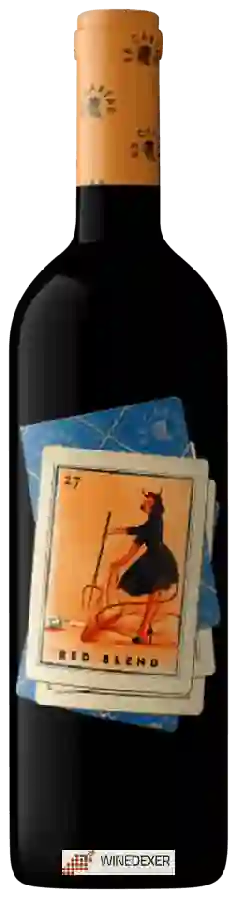
Winery 55 CartasRed Blend
 Red wine


In the mouth this red wine is a powerful with a nice balance between acidity and tannins.
This wine generally goes well with poultry, beef or veal.

Taste structure of the Red Blend from the Winery 55 Cartas
Light | Bold | |
Smooth | Tannic | |
Dry | Sweet | |
Soft | Acidic |
In the mouth the Red Blend of Winery 55 Cartas in the region of California is a powerful with a nice balance between acidity and tannins.
Food and wine pairings with Red Blend
Pairings that work perfectly with Red Blend



Original food and wine pairings with Red Blend

The Red Blend of Winery 55 Cartas matches generally quite well with dishes of beef, lamb or veal such as recipes of ramen burger, lamb chops with lemon and herbs or white wine fondue.
Details and technical informations about Winery 55 Cartas's Red Blend.
Discover the grape variety: Malvasia Fina
Structured, aromatic dry whites with a pale golden robe, an ample palate and moderate acidity, showing signature aromas of yellow fruits (pear, peach, apricot), white flowers (acacia), almond and schist mineral notes. Fine ageing potential. A traditional component of Douro DOC and Dão DOC whites and white Port. A Portuguese variety of the Malvasia family, widely grown in north-eastern Portugal.
Last vintages of this wine
The best vintages of Red Blend from Winery 55 Cartas are 0
Informations about the Winery 55 Cartas
The Winery 55 Cartas is one of of the world's greatest estates. It offers 3 wines for sale in the of California to come and discover on site or to buy online.

The wine region of California
Powerful, sunny reds: dense Napa Cabernet Sauvignon (blackcurrant, chocolate, tobacco, ample tannins), spicy, jammy Zinfandel from the Sierra Foothills, silky red-fruited Pinot Noir on the cool coast (Sonoma, Russian River, Central Coast). Opulent, buttery Chardonnay, notes of yellow fruit and vanilla. Varied climate, from the hot interior to the Pacific-cooled coast. 80% of US production, 139 AVAs including Napa (1st AVA, 1981).
The word of the wine: Rootstock
American vine on which a French vine is grafted. This is the consequence of the phylloxera that destroyed the vineyard at the end of the 19th century: after much trial and error, it was discovered that the "pest" spared the roots of the American vines, and the technique became widespread.




