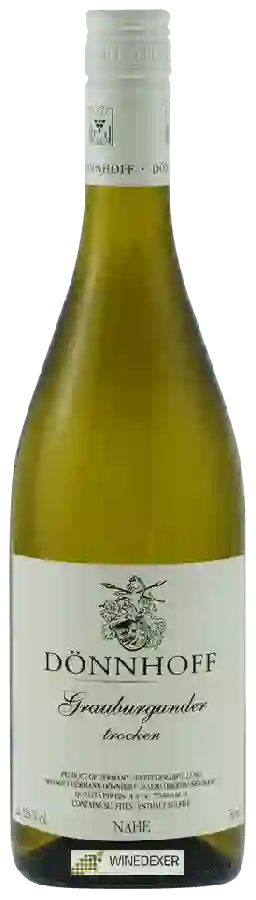
Winery DönnhoffGrauburgunder Trocken
 White wine



In the mouth this white wine is a powerful with a nice freshness.
This wine generally goes well with pork, cured meat or mushrooms.

Taste structure of the Grauburgunder Trocken from the Winery Dönnhoff
Light | Bold | |
Dry | Sweet | |
Soft | Acidic |
In the mouth the Grauburgunder Trocken of Winery Dönnhoff in the region of Nahe is a powerful with a nice freshness.
Wine flavors and olphactive analysis





On the nose the Grauburgunder Trocken of Winery Dönnhoff in the region of Nahe often reveals types of flavors of non oak, earth or microbio and sometimes also flavors of oak, tree fruit or citrus fruit.
Food and wine pairings with Grauburgunder Trocken
Pairings that work perfectly with Grauburgunder Trocken



Original food and wine pairings with Grauburgunder Trocken

The Grauburgunder Trocken of Winery Dönnhoff matches generally quite well with dishes of pork, spicy food or mushrooms such as recipes of roast pork in the oven, turkey escalope with curry or filet mignon with wild mushrooms.
Details and technical informations about Winery Dönnhoff's Grauburgunder Trocken.
Discover the grape variety: Pinot blanc
Round, supple whites with a soft palate, showing discreet aromas of apple, pear, fresh almond, white flowers and brioche notes. Moderate acidity, light finish. Star of Crémant d'Alsace (fine, taut sparkling) and base of Edelzwicker. Grown in Germany (Weissburgunder, Baden-Württemberg), northern Italy (Pinot Bianco, Alto Adige), Austria and Luxembourg. A white mutation of Pinot Noir.
Last vintages of this wine
The best vintages of Grauburgunder Trocken from Winery Dönnhoff are 2015, 2016, 2013, 2012 and 2019.
Informations about the Winery Dönnhoff
The Winery Dönnhoff is one of of the world's great estates. It offers 75 wines for sale in the of Nahe to come and discover on site or to buy online.

The wine region of Nahe
Homeland of a mineral Riesling of exceptional geological expression: lively, precise whites with notes of peach, citrus, green apple, gunflint and fine salinity, from taut dry to botrytised sweet. 75% whites, Riesling king (27%) complemented by round Pinot Gris and supple Pinot Blanc. Rising reds: silky Spätburgunder with red fruit, darker Dornfelder. 4,240 ha along the Nahe river, among the most diverse soils in Germany (180 formations).
The word of the wine: Gross
Champagne with between 6 and 15 grams of sugar (see dosage liqueur).


