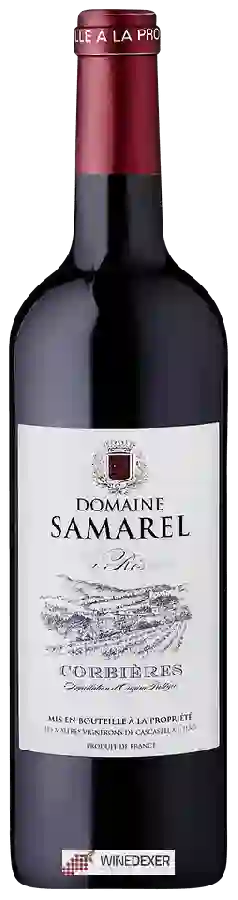
Domaine SamarelLa Réserve Corbières Rouge
 Red wine


In the mouth this red wine is a powerful with a nice balance between acidity and tannins.
This wine generally goes well with beef, veal or pasta.

Taste structure of the La Réserve Corbières Rouge from the Domaine Samarel
Light | Bold | |
Smooth | Tannic | |
Dry | Sweet | |
Soft | Acidic |
In the mouth the La Réserve Corbières Rouge of Domaine Samarel in the region of Languedoc-Roussillon is a powerful with a nice balance between acidity and tannins.
Food and wine pairings with La Réserve Corbières Rouge
Pairings that work perfectly with La Réserve Corbières Rouge



Original food and wine pairings with La Réserve Corbières Rouge
The La Réserve Corbières Rouge of Domaine Samarel matches generally quite well with dishes of beef, pasta or veal such as recipes of adapted vietnamese fondue, pasta with pistou or stuffed veal breast.
Details and technical informations about Domaine Samarel's La Réserve Corbières Rouge.
Discover the grape variety: Romorantin
Dry, vivid and structured whites with a golden robe, taut mouthfeel and sharp acidity, with aromas of citrus (lemon, grapefruit), apple, pear, white flowers, honey and pronounced chalky mineral notes. Good ageing potential, gaining wax and dried fruit notes with age. Near-exclusive star of Cour-Cheverny AOC in the Sologne. Very rare autochthonous Loire variety, introduced to the Loire valley by François I in 1519 according to tradition.
Last vintages of this wine

The best vintages of La Réserve Corbières Rouge from Domaine Samarel are 2015, 2011, 2014
Informations about the Domaine Samarel
The Domaine Samarel is one of of the world's greatest estates. It offers 2 wines for sale in the of Corbières to come and discover on site or to buy online.

The wine region of Corbières
Largest AOC in Languedoc, 95% Mediterranean reds. Signature old-vine Carignan (up to 60%): fleshy reds with black fruit, garrigue, black olive, spice and tight tannins. Blended with round, sunny Grenache, peppery Syrah, dense Mourvèdre and supple Cinsault. A few fresh rosés and whites (Grenache Blanc, Roussanne).
The wine region of Languedoc-Roussillon
Largest single French vineyard, dominated by sunny, generous reds. Spicy Syrah, candied Grenache (ripe fruit, garrigue), structured Carignan, deep Mourvèdre, supple Cinsault. Stars: structured Corbières, Minervois, Faugères, Saint-Chinian; round Côtes-du-Roussillon. Legendary vins doux naturels: Banyuls and Maury (fortified Grenache) with notes of cocoa, fig, prune.
The word of the wine: Bordeaux barrel
Barrels of 220 to 225 litres. The toasting of the barrel to bend the staves (curved boards used to make the barrels) can vary according to the coopers and the demand. A gentle and slow toasting has little effect on the aromas. On the other hand, a strong toasting gives aromas of coffee or cocoa which will influence the taste of the wine. A wine barrel has already been aged for a year and has less impact on the wine than a new barrel.