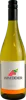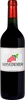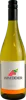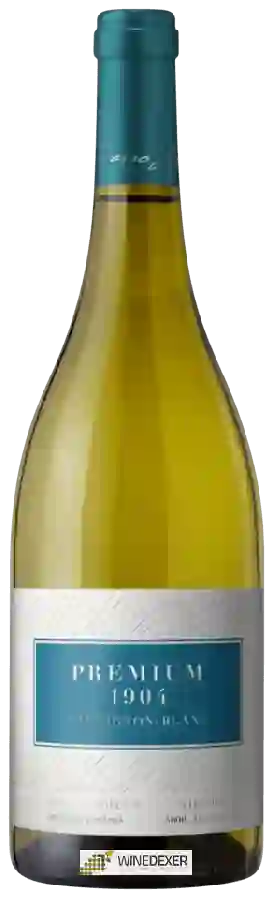
Winery Premium 1904Sauvignon Blanc
 White wine



In the mouth this white wine is a with a nice freshness.
This wine generally goes well with vegetarian, shellfish or goat cheese.
Taste structure of the Sauvignon Blanc from the Winery Premium 1904
Light | Bold | |
Dry | Sweet | |
Soft | Acidic |
In the mouth the Sauvignon Blanc of Winery Premium 1904 in the region of Castille is a with a nice freshness.
Food and wine pairings with Sauvignon Blanc
Pairings that work perfectly with Sauvignon Blanc



Original food and wine pairings with Sauvignon Blanc
The Sauvignon Blanc of Winery Premium 1904 matches generally quite well with dishes of shellfish, vegetarian or goat cheese such as recipes of pasta with scampi, quiche lorraine or treviso and goat cheese pie.
Details and technical informations about Winery Premium 1904's Sauvignon Blanc.
Discover the grape variety: Reichensteiner
Intraspecific crossing between the müller-thurgau and a variety resulting from the crossing (madeleine angevine x calabre blanc) obtained in Germany in 1939 by Heinrich Birk (1898-1973). It can be found in France (Alsace, etc.), Great Britain, the Netherlands, Germany, Belgium, Switzerland, New Zealand, etc.
Last vintages of this wine
The best vintages of Sauvignon Blanc from Winery Premium 1904 are 2015, 2018, 0, 2016 and 2014.
Informations about the Winery Premium 1904
The Winery Premium 1904 is one of of the world's greatest estates. It offers 8 wines for sale in the of Castille to come and discover on site or to buy online.

The wine region of Castille
Castilla-La Mancha is a large region located South and east of the Spanish capital, Madrid. Inexpensive table wines are produced from a variety of Grapes. Higher quality wines are increasingly available, but the region is traditionally known as a source of low quality bulk wine. More than half of Spain's grapes are grown here.
The word of the wine: Chaptalization
The addition of sugar at the time of fermentation of the must, an ancient practice, but theorized by Jean-Antoine Chaptal at the dawn of the 19th century. The sugar is transformed into alcohol and allows the natural degree of the wine to be raised in a weak or cold year, or - more questionably - when the winegrower has a harvest that is too large to obtain good maturity.