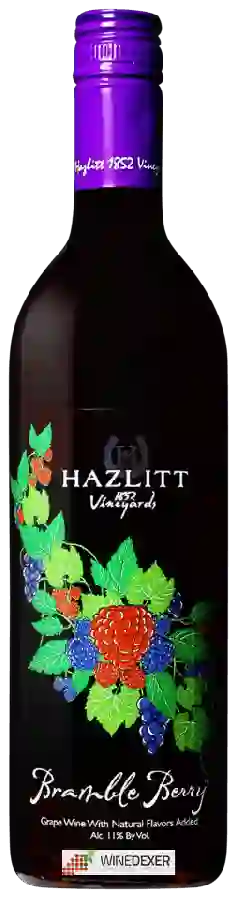
Winery Hazlitt 1852Bramble Berry
 Red wine


This wine generally goes well with
The Bramble Berry of the Winery Hazlitt 1852 is in the top 10 of wines of Finger Lakes.

Wine flavors and olphactive analysis


On the nose the Bramble Berry of Winery Hazlitt 1852 in the region of New York often reveals types of flavors of oak, red fruit or black fruit.
Details and technical informations about Winery Hazlitt 1852's Bramble Berry.
Discover the grape variety: Concord
Fruity, often sweet reds with a dense purple robe, light tannins and preserved acidity. Intense aromas of fresh grape, strawberry, raspberry and the characteristic foxy note (musky animal typical of Vitis labrusca). Often vinified sweet or semi-sweet. Pillar of American viticulture in the 19th century, today mainly used for grape juice, Welch's jelly and American kosher wine. Vitis labrusca hybrid selected around 1840 by Ephraim Bull in Concord, Massachusetts.
Last vintages of this wine
The best vintages of Bramble Berry from Winery Hazlitt 1852 are 2008, 0
Informations about the Winery Hazlitt 1852
The Winery Hazlitt 1852 is one of of the world's greatest estates. It offers 26 wines for sale in the of Finger Lakes to come and discover on site or to buy online.

The wine region of Finger Lakes
Quality hub of the American northeast, signature Riesling: dry, lively, mineral whites with notes of green apple, lemon, white peach and wet stone, sharp acidity comparable to the best Germans. Also off-dry and sweet botrytised versions. Precise Chardonnay, fine, fresh Pinot Noir (red fruits), peppery Cabernet Franc. Continental climate tempered by 11 glacial lakes (Cayuga, Seneca).
The wine region of New York
America's 3rd wine state by volume, striking diversity. Finger Lakes the signature: cool-climate Riesling, dry to off-dry, mineral and lively with notes of lime, apple, evolving petrol and white flowers — a US benchmark. Warmer Long Island for peppery Cabernet Franc and supple Merlot. Hudson Valley (Seyval, Vidal).
The word of the wine: Decanting
A sommelier uses a decanter to separate the clear wine from the solid parts in a bottle.