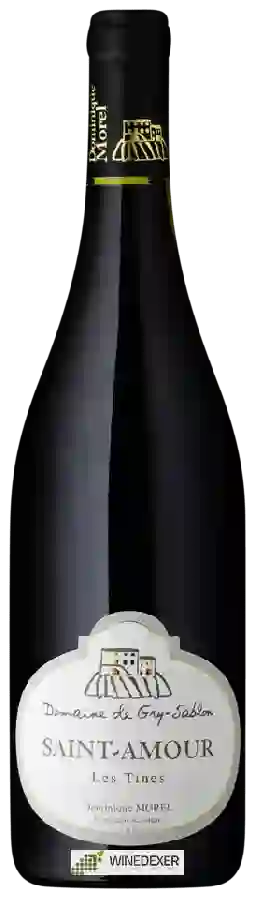
Domaine de Gry Sablon - Dominique MorelSaint-Amour Les Tines
 Red wine



In the mouth this red wine is a with a nice freshness.
This wine generally goes well with pork, poultry or veal.
Taste structure of the Saint-Amour Les Tines from the Domaine de Gry Sablon - Dominique Morel
Light | Bold | |
Smooth | Tannic | |
Dry | Sweet | |
Soft | Acidic |
In the mouth the Saint-Amour Les Tines of Domaine de Gry Sablon - Dominique Morel in the region of Beaujolais is a with a nice freshness.
Wine flavors and olphactive analysis


On the nose the Saint-Amour Les Tines of Domaine de Gry Sablon - Dominique Morel in the region of Beaujolais often reveals types of flavors of earth, red fruit.
Food and wine pairings with Saint-Amour Les Tines
Pairings that work perfectly with Saint-Amour Les Tines



Original food and wine pairings with Saint-Amour Les Tines

The Saint-Amour Les Tines of Domaine de Gry Sablon - Dominique Morel matches generally quite well with dishes of pasta, veal or pork such as recipes of lasagne simplissimo, home-made coq au vin or pork roulades with cream and mushrooms.
Details and technical informations about Domaine de Gry Sablon - Dominique Morel's Saint-Amour Les Tines.
Discover the grape variety: Courbu blanc
Native variety of the Pyrenean vineyard that does not correspond to the white form of the courbu noir. It should not be confused with the petit courbu, published genetic analysis has shown that it is related to one or more varieties including the lercat and for more details click here! Courbu blanc is registered in the official catalogue of wine grape varieties, list A1.
Last vintages of this wine
The best vintages of Saint-Amour Les Tines from Domaine de Gry Sablon - Dominique Morel are 2016, 2015, 2013, 2012 and 2008.
Informations about the Domaine de Gry Sablon - Dominique Morel
The Domaine de Gry Sablon - Dominique Morel is one of of the world's greatest estates. It offers 39 wines for sale in the of Saint-Amour to come and discover on site or to buy online.

The wine region of Saint-Amour
Saint-Amour is the Northernmost of the ten Beaujolais crus, located just South of the Mâcon appellations of Pouilly-Fuisse and Saint-Véran. Saint-Amour wines are among the lightest of the Beaujolais crus, often displaying Spicy berry and stone fruit characters with a marked minerality. Just under 800 acres (320 ha) are planted with the Gamay Grape variety on the south and east facing hillsides on the western banks of the Saône River, and make up the Saint-Amour appellation's wine growing area. While most of the ten Beaujolais crus were created in the 1930s, Saint-Amour was only officially delimited as a cru in February 1946.
The wine region of Beaujolais
Beaujolais is an important wine region in eastern France, famous for its vibrant, Fruity red wines made from Gamay. It is located immediately South of Burgundy, of which it is sometimes considered a Part, although it is in the administrative region of Rhône. The extensive plantings of Gamay in this region make Beaujolais one of the few regions in the world that is so concentrated on a single Grape variety. Pinot Noir is used in small quantities in red and rosé wines, but in the name of regional identity, it is being phased out and will only be allowed until the 2015 harvest.
The word of the wine: Castle
A term often used to designate wineries, even if they do not have a real castle.