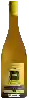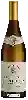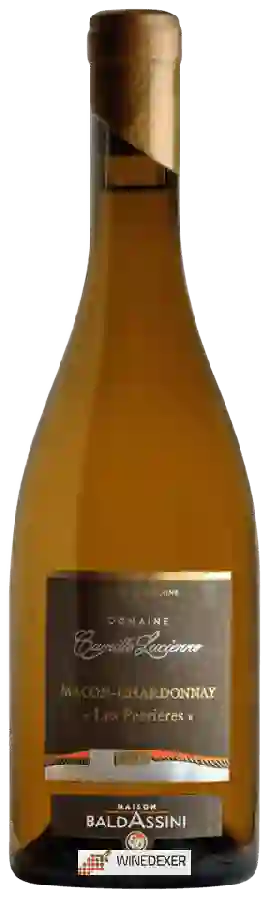
Domaine Camille LucienneMâcon-Chardonnay 'Les Perrière'
 wine
wine
This wine generally goes well with
The Mâcon-Chardonnay 'Les Perrière' of the Domaine Camille Lucienne is in the top 0 of wines of Mâcon-Chardonnay.
Details and technical informations about Domaine Camille Lucienne's Mâcon-Chardonnay 'Les Perrière'.
Discover the grape variety: Montils
Montils blanc is a grape variety that originated in France (Charente). It produces a variety of grape specially used for wine making. It is rare to find this grape to eat on our tables. It should be noted that this grape variety can also be used for the elaboration of eaux de vie. This variety of vine is characterized by bunches of medium size, and grapes of medium size. Montils blanc can be found in several vineyards: South-West, Cognac, Bordeaux, Loire Valley, Provence & Corsica, Rhone Valley, Savoie & Bugey, Beaujolais.
Informations about the Domaine Camille Lucienne
The Domaine Camille Lucienne is one of of the world's greatest estates. It offers 3 wines for sale in the of Mâcon-Chardonnay to come and discover on site or to buy online.

The wine region of Mâcon-Chardonnay
The wine region of Mâcon-Chardonnay is located in the region of Mâcon of Burgundy of France. Wineries and vineyards like the Domaine des Crêts or the Domaine Bret Brothers & The Soufrandière produce mainly wines white. The most planted grape varieties in the region of Mâcon-Chardonnay are Chardonnay, they are then used in wines in blends or as a single variety. On the nose of Mâcon-Chardonnay often reveals types of flavors of apples, vegetal or cheese and sometimes also flavors of stone fruit, orange or honey.
The wine region of Burgundy
Bourgogne is the catch-all regional appellation title of the Burgundy wine region in eastern France ("Bourgogne" is the French name for Burgundy). Burgundy has a Complex and comprehensive appellation system; counting Premier Cru and Grand Cru titles, the region has over 700 appellation titles for its wines. Thus, Burgundy wines often come from one Vineyard (or several separate vineyards) without an appellation title specific to the region, Village or even vineyard. A standard Burgundy wine may be made from grapes grown in one or more of Burgundy's 300 communes.
The word of the wine: Oenologist
Specialist in wine-making techniques. It is a profession and not a passion: one can be an oenophile without being an oenologist (and the opposite too!). Formerly attached to the Faculty of Pharmacy, oenology studies have become independent and have their own university course. Learning to make wine requires a good chemical background but also, increasingly, a good knowledge of the plant. Some oenologists work in laboratories (analysis). Others, the consulting oenologists, work directly in the properties.