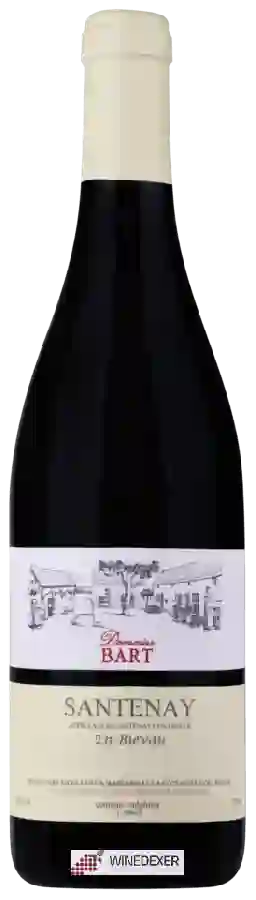
Domaine BartEn Bievau Santenay
 Red wine


In the mouth this red wine is a with a nice freshness.
This wine generally goes well with poultry, beef or veal.

Taste structure of the En Bievau Santenay from the Domaine Bart
Light | Bold | |
Smooth | Tannic | |
Dry | Sweet | |
Soft | Acidic |
In the mouth the En Bievau Santenay of Domaine Bart in the region of Burgundy is a with a nice freshness.
Wine flavors and olphactive analysis

On the nose the En Bievau Santenay of Domaine Bart in the region of Burgundy often reveals types of flavors of microbio.
Food and wine pairings with En Bievau Santenay
Pairings that work perfectly with En Bievau Santenay



Original food and wine pairings with En Bievau Santenay

The En Bievau Santenay of Domaine Bart matches generally quite well with dishes of beef, veal or game (deer, venison) such as recipes of cabri en colombo with creole sauce, pljeskavica (balkan hamburger) or duck leg confit in white wine.
Details and technical informations about Domaine Bart's En Bievau Santenay.
Discover the grape variety: Pinot noir
Elegant reds, light in colour with silky tannins, showing strawberry, cherry and raspberry aromas, evolving to forest floor, mushroom and spice with age. Fresh acidity, delicate finish. Star of the Côte d'Or (Romanée-Conti, Chambertin, Volnay), pillar of Champagne (Blanc de Noirs) and signature of Oregon, Central Otago and Sonoma Coast. An early-ripening Burgundian variety, one of the world's greatest.
Last vintages of this wine

The best vintages of En Bievau Santenay from Domaine Bart are 2015, 2013, 2016, 2014 and 2010.
Informations about the Domaine Bart
The Domaine Bart is one of of the world's greatest estates. It offers 28 wines for sale in the of Santenay to come and discover on site or to buy online.

The wine region of Santenay
Southernmost cru of the Cote de Beaune: signature Pinot Noir as king red (~80%) — ruby robe with notes of cherry, raspberry, blackberry, wild strawberry, violet and a hint of spice, supple tannins and a generous finish, more accessible than its northern neighbours. Chardonnay as a broad white (citrus, apple, almond, honey, white flowers). AOC (1937), ~330 ha on Santenay and Remigny, 12 Premiers Crus (Les Gravieres, La Comme), limestone marls, ages 4-10 years.
The wine region of Burgundy
Absolute reference for great terroir wines: opulent, mineral Chardonnay in whites (chiselled Chablis, buttery Meursault, majestic Montrachet), fine and silky Pinot Noir in reds (full-bodied Gevrey, structured Pommard, delicate Volnay). Exceptional age-worthy wines with complex notes - red fruits, undergrowth, butter, hazelnut. Some lively Aligoté and light Gamay (Mâconnais). 29,500 ha, 84 tiered AOCs (Régionale, Village, 1er Cru, Grand Cru), 1,247 UNESCO Climats.
The word of the wine: Maceration
Prolonged contact and exchange between the juice and the grape solids, especially the skin. Not to be confused with the time of fermentation, which follows maceration. The juice becomes loaded with colouring matter and tannins, and acquires aromas. For a rosé, the maceration is short so that the colour does not "rise" too much. For white wines too, a "pellicular maceration" can be practised, which allows the wine to acquire more fat.