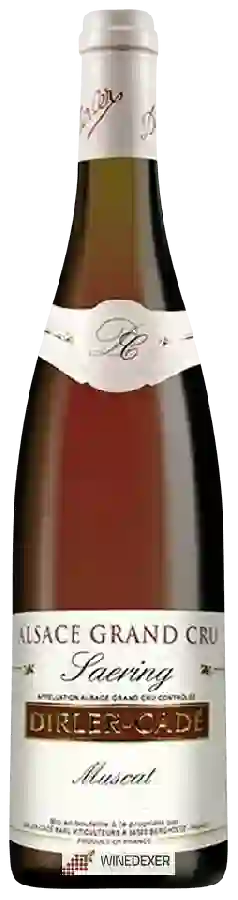
Winery Dirler-CadéAlsace Grand Cru Saering Muscat
 White wine



This wine generally goes well with spicy food and sweet desserts.

Wine flavors and olphactive analysis



On the nose the Alsace Grand Cru Saering Muscat of Winery Dirler-Cadé in the region of Alsace often reveals types of flavors of earth, vegetal or tree fruit and sometimes also flavors of spices, citrus fruit.
Food and wine pairings with Alsace Grand Cru Saering Muscat
Pairings that work perfectly with Alsace Grand Cru Saering Muscat


Original food and wine pairings with Alsace Grand Cru Saering Muscat
The Alsace Grand Cru Saering Muscat of Winery Dirler-Cadé matches generally quite well with dishes of spicy food or sweet desserts such as recipes of monkfish armorican style or express kiwi and chocolate tartlet.
Details and technical informations about Winery Dirler-Cadé's Alsace Grand Cru Saering Muscat.
Discover the grape variety: Durif
Powerful, deeply coloured reds with an inky, near-black robe, firm tannins and dense palate. Intense aromas of blackberry, plum, blackcurrant, black pepper, chocolate, spices and balsamic notes. Fine ageing potential. Near-extinct in France, it became a star as Petite Sirah in California (Napa, Lodi, Paso Robles) and is emblematic of Rutherglen, Australia. French variety created in 1880 by François Durif in the Isère (spontaneous cross of Syrah × Peloursin).
Last vintages of this wine
The best vintages of Alsace Grand Cru Saering Muscat from Winery Dirler-Cadé are 2009, 2012, 2015, 2014 and 2016.
Informations about the Winery Dirler-Cadé
The Winery Dirler-Cadé is one of of the world's great estates. It offers 48 wines for sale in the of Alsace Grand Cru 'Saering' to come and discover on site or to buy online.

The wine region of Alsace Grand Cru 'Saering'
Grand Cru north-east of Guebwiller adjacent to Kitterlé (Haut-Rhin, 26. 75 ha at 260-300 m, east-south-east exposure, marly-sandy soils with pebbles on Jurassic limestone, cited since 1250). Riesling as dominant signature white (84%) — elegant profile with floral fragrances, perceptible fruit from youth, finesse, saline sensation and accessible minerality with a softer acidity. Gewürztraminer, Muscat and Pinot Gris as distinctive complements.
The wine region of Alsace
Capital of great French aromatic whites, most often dry and single-varietal. Straight, mineral Riesling (lemon, gunflint), opulent, exuberant Gewurztraminer (lychee, rose, spices), round, smoky Pinot Gris, floral, crisp Muscat, supple Pinot Blanc. Fine, fruity Crémants d'Alsace, exceptional sweet Vendanges Tardives and Sélection de Grains Nobles. 15,500 ha at the foot of the Vosges on varied soils, 51 Grands Crus since 1975.
The word of the wine: Disgorging (champagne)
This is the evacuation of the deposit formed by the yeasts during the second fermentation in the bottle, by opening the bottle. The missing volume is completed with the liqueur de dosage - a mixture of wine and cane sugar - before the final cork is placed. For some years now, some producers have been replacing this sugar with rectified concentrated musts (concentrated grape juice) which give excellent results. A too recent dosage (less than three months) harms the gustatory harmony of the champagne.