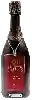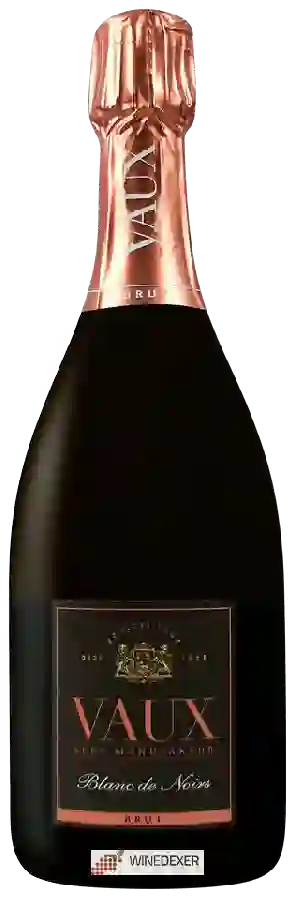
Winery Schloss VauxBlanc de Noirs Brut
 Sparkling wine



This wine generally goes well with vegetarian
Wine flavors and olphactive analysis


On the nose the Blanc de Noirs Brut of Winery Schloss Vaux in the region of Rheingau often reveals types of flavors of tree fruit, red fruit.
Food and wine pairings with Blanc de Noirs Brut
Pairings that work perfectly with Blanc de Noirs Brut

Original food and wine pairings with Blanc de Noirs Brut
The Blanc de Noirs Brut of Winery Schloss Vaux matches generally quite well with dishes of vegetarian such as recipes of leek, goat cheese and bacon quiche.
Details and technical informations about Winery Schloss Vaux's Blanc de Noirs Brut.
Discover the grape variety: Ugni
Ugni blanc is a grape variety originating from Italy. It produces a variety of grape specially used for the elaboration of wine. It is rare to find this grape to eat on our tables. This variety of grape is characterized by large bunches and small to medium sized grapes. Ugni blanc can be found in many vineyards: South West, Cognac, Bordeaux, Provence & Corsica, Rhone valley, Languedoc & Roussillon, Armagnac, Loire valley, Savoie & Bugey, Beaujolais.
Last vintages of this wine
The best vintages of Blanc de Noirs Brut from Winery Schloss Vaux are 2012, 2018, 2017, 2014 and 2013.
Informations about the Winery Schloss Vaux
The Winery Schloss Vaux is one of of the world's greatest estates. It offers 23 wines for sale in the of Rheingau to come and discover on site or to buy online.

The wine region of Rheingau
Rheingau is one of the most important of Germany's 13 Anbaugebiete wine regions. However it is far from the biggest; with 3,076 hectares (7,600 acres) of Vineyard">Vineyards documented in 2012, its output is around one tenth of that from the Pfalz and Rheinhessen regions. Located on the Rhine a 20-minute drive west of Frankfurt, the -gau suffix denotes that it was once a county of the Frankish Empire. The classic Rheingau wine is a DryRiesling with pronounced Acidity and aromas of citrus fruits and smoke-tinged minerality – typically more "masculine" than its equivalent from the Mosel.
The word of the wine: Old vines
There are no specific regulations governing the term "vieilles vignes". After 20 to 25 years, the yields stabilize and tend to decrease, the vines are deeply rooted, and the grapes that come from them give richer, more concentrated, more sappy wines, expressing with more nuance the characteristics of their terroir. It is possible to find plots of vines that claim to be a century old.