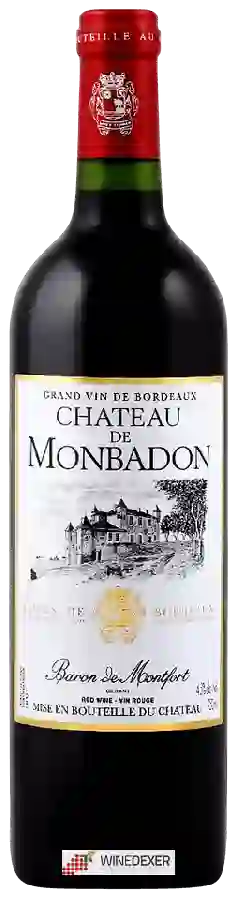
Château de MonbadonCôtes de Bordeaux
 Red wine



This wine is a blend of 2 varietals which are the Cabernet-Sauvignon and the Merlot.
In the mouth this red wine is a powerful with a nice balance between acidity and tannins.
This wine generally goes well with poultry, beef or veal.

Taste structure of the Côtes de Bordeaux from the Château de Monbadon
Light | Bold | |
Smooth | Tannic | |
Dry | Sweet | |
Soft | Acidic |
In the mouth the Côtes de Bordeaux of Château de Monbadon in the region of Bordeaux is a powerful with a nice balance between acidity and tannins.
Wine flavors and olphactive analysis


On the nose the Côtes de Bordeaux of Château de Monbadon in the region of Bordeaux often reveals types of flavors of non oak, earth or oak.
Food and wine pairings with Côtes de Bordeaux
Pairings that work perfectly with Côtes de Bordeaux



Original food and wine pairings with Côtes de Bordeaux

The Côtes de Bordeaux of Château de Monbadon matches generally quite well with dishes of beef, veal or game (deer, venison) such as recipes of dombrés and pig tails, veal roast, country style or mymy's golden apples (squash).
Details and technical informations about Château de Monbadon's Côtes de Bordeaux.
Discover the grape variety: Cabernet-Sauvignon
Structured, tannic reds, deeply coloured, with aromas of blackcurrant, blackberry, cedar, tobacco and graphite, underpinned by firm acidity and fine ageing potential. Cornerstone of the great Médoc estates (Pauillac, Saint-Estèphe, Saint-Julien) and signature of Napa Valley, Coonawarra and Maipo. The world's most planted red variety, a natural cross of Cabernet Franc x Sauvignon Blanc born in Bordeaux.
Last vintages of this wine
The best vintages of Côtes de Bordeaux from Château de Monbadon are 2012, 2010, 2015, 2009
Informations about the Château de Monbadon
The Château de Monbadon is one of of the world's greatest estates. It offers 4 wines for sale in the of Côtes de Bordeaux to come and discover on site or to buy online.

The wine region of Côtes de Bordeaux
Unified Bordeaux AOC (2009) gathering 4 right-bank denominations: Blaye, Cadillac, Castillon, Francs. Signature Merlot dominant in red: supple, accessible reds with signature notes of plum, ripe cherry, cocoa, undergrowth and an herbaceous touch, round tannins and a moreish palate — everyday Bordeaux with excellent value for money. Peppery Cabernet Franc, firm Cabernet Sauvignon complete. Cadillac in botrytised off-dry/sweet (honey, apricot).
The wine region of Bordeaux
World-renowned age-worthy reds, led by round Merlot (plum, black fruit) or firm Cabernet Sauvignon (blackcurrant, cedar, graphite), blended with Cabernet Franc and Petit Verdot for tannic structure. Structured Médoc and Graves, velvety Saint-Émilion and Pomerol. Also crisp dry whites (Sauvignon/Sémillon) and opulent sweet Sauternes with honey and candied fruit. A 110,000 ha Gironde vineyard, 65 appellations, cradle of the 1855 classified growths.
The word of the wine: Tanin
A natural compound contained in the skin of the grape, the seed or the woody part of the bunch, the stalk. The maceration of red wines allows the extraction of tannins, which give the texture, the solidity and also the mellowness when the tannins are "ripe". The winemaker seeks above all to extract the tannins from the skin, the ripest and most noble. The tannins of the seed or stalk, which are "greener", especially in average years, give the wine hardness and astringency. The wines of Bordeaux (based on Cabernet and Merlot) are full of tannins, those of Burgundy much less so, with Pinot Noir containing little.