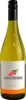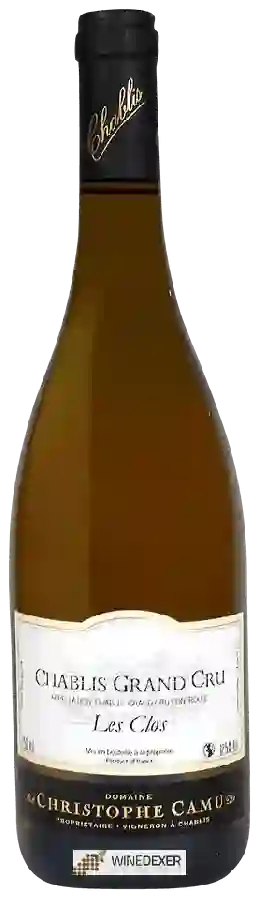
Domaine Christophe CamuChablis Grand Cru 'Les Clos'
 White wine


In the mouth this white wine is a powerful with a nice freshness.
This wine generally goes well with pork, rich fish (salmon, tuna etc) or shellfish.

Taste structure of the Chablis Grand Cru 'Les Clos' from the Domaine Christophe Camu
Light | Bold | |
Dry | Sweet | |
Soft | Acidic |
In the mouth the Chablis Grand Cru 'Les Clos' of Domaine Christophe Camu in the region of Burgundy is a powerful with a nice freshness.
Wine flavors and olphactive analysis


On the nose the Chablis Grand Cru 'Les Clos' of Domaine Christophe Camu in the region of Burgundy often reveals types of flavors of microbio.
Food and wine pairings with Chablis Grand Cru 'Les Clos'
Pairings that work perfectly with Chablis Grand Cru 'Les Clos'



Original food and wine pairings with Chablis Grand Cru 'Les Clos'

The Chablis Grand Cru 'Les Clos' of Domaine Christophe Camu matches generally quite well with dishes of pork, shellfish or rich fish (salmon, tuna etc) such as recipes of caramelized pork ribs, shrimp marinade or chinese fondue.
Details and technical informations about Domaine Christophe Camu's Chablis Grand Cru 'Les Clos'.
Discover the grape variety: Chardonnay
Whites with many faces: mineral and taut at Chablis (lemon, green apple, flint), opulent and buttery at Meursault and Puligny-Montrachet (hazelnut, brioche, yellow fruits), tense and chalky in Champagne (Blanc de Blancs). Also vinified sparkling and widely exported (Sonoma, Margaret River, Casablanca). A Burgundian variety, a cross of Pinot Noir × Gouais Blanc, half-sibling of Aligoté.
Last vintages of this wine
The best vintages of Chablis Grand Cru 'Les Clos' from Domaine Christophe Camu are 0
Informations about the Domaine Christophe Camu
The Domaine Christophe Camu is one of of the world's greatest estates. It offers 16 wines for sale in the of Chablis Grand Cru 'Les Clos' to come and discover on site or to buy online.

The wine region of Chablis Grand Cru 'Les Clos'
Largest (26 ha) and most emblematic of Chablis' seven Grand Crus, 100% Chardonnay on the right bank of the Serein: whites of exceptional longevity and complexity. Pale gold, powerful nose of citrus, white fruits, flowers and iodine, evolving to honey, truffle and petrol with age. Varied soils — stony and calcareous at top, clayey below, Kimmeridgian marl. South/south-west exposure, mineral firmness, age 15–25 years.
The wine region of Burgundy
Absolute reference for great terroir wines: opulent, mineral Chardonnay in whites (chiselled Chablis, buttery Meursault, majestic Montrachet), fine and silky Pinot Noir in reds (full-bodied Gevrey, structured Pommard, delicate Volnay). Exceptional age-worthy wines with complex notes - red fruits, undergrowth, butter, hazelnut. Some lively Aligoté and light Gamay (Mâconnais). 29,500 ha, 84 tiered AOCs (Régionale, Village, 1er Cru, Grand Cru), 1,247 UNESCO Climats.
The word of the wine: Tanin
A natural compound contained in the skin of the grape, the seed or the woody part of the bunch, the stalk. The maceration of red wines allows the extraction of tannins, which give the texture, the solidity and also the mellowness when the tannins are "ripe". The winemaker seeks above all to extract the tannins from the skin, the ripest and most noble. The tannins of the seed or stalk, which are "greener", especially in average years, give the wine hardness and astringency. The wines of Bordeaux (based on Cabernet and Merlot) are full of tannins, those of Burgundy much less so, with Pinot Noir containing little.