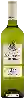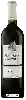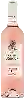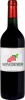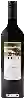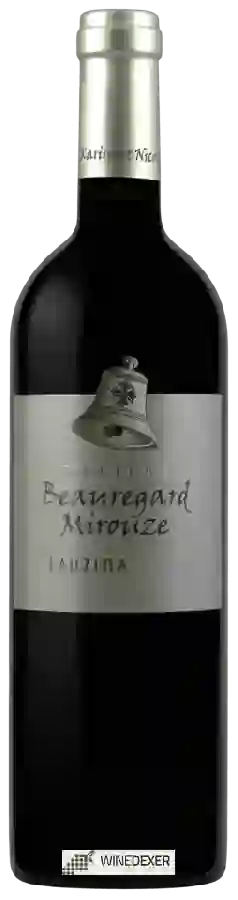
Château Beauregard MirouzeLauzina Rouge
 Red wine



In the mouth this red wine is a powerful with a nice balance between acidity and tannins.
This wine generally goes well with beef, veal or pasta.
Taste structure of the Lauzina Rouge from the Château Beauregard Mirouze
Light | Bold | |
Smooth | Tannic | |
Dry | Sweet | |
Soft | Acidic |
In the mouth the Lauzina Rouge of Château Beauregard Mirouze in the region of Languedoc-Roussillon is a powerful with a nice balance between acidity and tannins.
Wine flavors and olphactive analysis



On the nose the Lauzina Rouge of Château Beauregard Mirouze in the region of Languedoc-Roussillon often reveals types of flavors of oaky, black currant or non oak and sometimes also flavors of earth, oak or spices.
Food and wine pairings with Lauzina Rouge
Pairings that work perfectly with Lauzina Rouge



Original food and wine pairings with Lauzina Rouge
The Lauzina Rouge of Château Beauregard Mirouze matches generally quite well with dishes of beef, pasta or veal such as recipes of beef tagine with prunes and almonds, phad thai (thai style fried noodles) or shoulder of lamb stuffed with cognac.
Details and technical informations about Château Beauregard Mirouze's Lauzina Rouge.
Discover the grape variety: Raisaine
Most certainly Ardéchoise, formerly cultivated in the region of Privas, Aubenas, Joyeuse and Largentière. It is the result of a natural intra-specific crossing between the black ribier and the red grec. Today, Raisaine is totally absent from the vineyards and is therefore in danger of disappearing, although it is listed in the Official Catalogue of Wine Grapes, list A.
Last vintages of this wine
The best vintages of Lauzina Rouge from Château Beauregard Mirouze are 2013, 2016, 2011, 2015
Informations about the Château Beauregard Mirouze
The Château Beauregard Mirouze is one of of the world's greatest estates. It offers 18 wines for sale in the of Corbières to come and discover on site or to buy online.

The wine region of Corbières
Corbières is an important appellation in the Languedoc-roussillon">Languedoc-Roussillon region of southern France. It is one of the best known and most productive appellations in the Languedoc. The Corbières vineyards produce large quantities of red and rosé wines, as well as a growing number of white wines. The reds are the strongest Part of the appellation; they are reputedly Rich and herbal, made from Grenache, Syrah, Mourvèdre, Lledoner Pelut and Carignan.
The wine region of Languedoc-Roussillon
Languedoc (formerly Coteaux du Languedoc) is a key appellation used in the Languedoc-Roussillon wine region of southern France. It covers Dry table wines of all three colors (red, white and rosé) from the entire region, but leaves Sweet and Sparkling wines to other more specialized appellations. About 75% of all Languedoc wines are red, with the remaining 25% split roughly down the middle between whites and rosés. The appellation covers most of the Languedoc region and almost a third of all the vineyards in France.
The word of the wine: Lies
A deposit formed by dead yeast after fermentation. Some white wines are aged on their lees, which makes their aromas and structure more complex and richer.