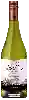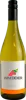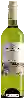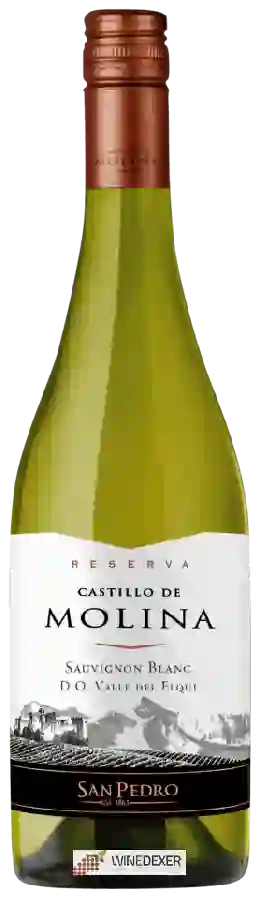
Winery San PedroCastillo de Molina Sauvignon Blanc (Reserva)
 White wine



In the mouth this white wine is a with a nice freshness.
This wine generally goes well with vegetarian, shellfish or goat cheese.

Taste structure of the Castillo de Molina Sauvignon Blanc (Reserva) from the Winery San Pedro
Light | Bold | |
Dry | Sweet | |
Soft | Acidic |
In the mouth the Castillo de Molina Sauvignon Blanc (Reserva) of Winery San Pedro in the region of Coquimbo is a with a nice freshness.
Wine flavors and olphactive analysis






On the nose the Castillo de Molina Sauvignon Blanc (Reserva) of Winery San Pedro in the region of Coquimbo often reveals types of flavors of grapefruit, tropical or citrus and sometimes also flavors of apples, peach or green apple.
Food and wine pairings with Castillo de Molina Sauvignon Blanc (Reserva)
Pairings that work perfectly with Castillo de Molina Sauvignon Blanc (Reserva)



Original food and wine pairings with Castillo de Molina Sauvignon Blanc (Reserva)
The Castillo de Molina Sauvignon Blanc (Reserva) of Winery San Pedro matches generally quite well with dishes of shellfish, vegetarian or goat cheese such as recipes of pasta with mussels, summer tuna quiche or potato and goat cheese gratin.
Details and technical informations about Winery San Pedro's Castillo de Molina Sauvignon Blanc (Reserva).
Discover the grape variety: Bicane
Simple, lively dry whites with a pale golden robe, a supple palate with preserved acidity, and undemonstrative aromas of citrus and white flowers. Vigorous and productive, once distilled in Cognac. Now marginal but preserved in Cognaçais varietal collections, a witness to Charentes heritage. French autochthonous variety from the South-West, father of Admirable de Courtiller via a cross with Chasselas.
Last vintages of this wine
The best vintages of Castillo de Molina Sauvignon Blanc (Reserva) from Winery San Pedro are 2019, 2018, 2010, 2015 and 2017.
Informations about the Winery San Pedro
The Winery San Pedro is one of of the world's great estates. It offers 188 wines for sale in the of Elqui Valley to come and discover on site or to buy online.

The wine region of Elqui Valley
Northernmost valley of Chile at the edge of the Atacama desert, very sunny desert climate (<70 mm rain/year), cool nights from the Pacific and the Andes. Syrah signature as king red: intense and concentrated with notes of black mulberry, cassis, violet, black pepper, olive, garrigue and a schistose mineral touch, firm tannins and sunny palate — unique high-altitude typicity. Zippy herbal Sauvignon Blanc in complement. Historic cradle of Chilean Pisco since the 16th c.
The wine region of Coquimbo
Chile's northernmost wine region (600 km north of Santiago), covering the Elqui, Limarí and Choapa valleys under a semi-desert climate cooled by the Pacific Camanchaca fog and the Andes. Syrah is the flagship red — intense blackcurrant, blackberry, black pepper, olive and a mineral-saline altitude edge, fine tannins and elegant freshness. Structured Cabernet Sauvignon. Taut Chardonnay and Sauvignon Blanc with citrus notes.
The word of the wine: Open
Said of a wine with a full and expressive nose, generally at its peak.