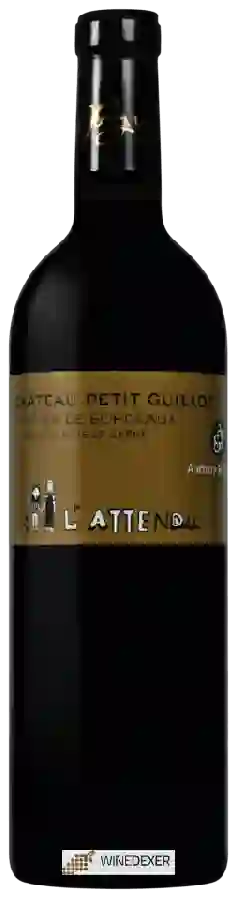
Château Petit GuillotL'Attendu Côtes de Bordeaux
 wine
wine
This wine generally goes well with
The L'Attendu Côtes de Bordeaux of the Château Petit Guillot is in the top 0 of wines of Côtes de Bordeaux.
Details and technical informations about Château Petit Guillot's L'Attendu Côtes de Bordeaux.
Discover the grape variety: Dimiat
This variety is cultivated in practically all of Bulgaria, much more so in the region around the Black Sea. Among white varieties, it is still the most widely planted in this country, just ahead of rkatziteli. It is also found in the former Yugoslavia, Albania, Romania, Hungary, Turkey and Greece. It is believed to be the result of a natural intraspecific cross between coarna alba - a Romanian variety - and white gouais.
Last vintages of this wine



The best vintages of L'Attendu Côtes de Bordeaux from Château Petit Guillot are 0
Informations about the Château Petit Guillot
The Château Petit Guillot is one of of the world's greatest estates. It offers 6 wines for sale in the of Côtes de Bordeaux to come and discover on site or to buy online.

The wine region of Côtes de Bordeaux
The Côtes de Bordeaux appellation was created in 2009 to merge four existing appellations used in the Bordeaux region of France. These four appellations are The Premières Côtes de Blaye, Côtes de Castillon, Côtes de Francs and the red wines of the Cadillac region. The latter were previously under the appellation Premières Côtes de Bordeaux. The changes were a commercially motivated decision, intended to create unity between these important but lesser known appellations.
The wine region of Bordeaux
Bordeaux, in southwestern France, is one of the most famous, prestigious and prolific wine regions in the world. The majority of Bordeaux wines (nearly 90% of the production Volume) are the Dry, medium and Full-bodied red Bordeaux blends for which it is famous. The finest (and most expensive) are the wines of the great châteaux of Haut-Médoc and the right bank appellations of Saint-Émilion and Pomerol. The former focuses (at the highest level) on Cabernet Sauvignon, the latter on Merlot.
The word of the wine: Gout (wine of)
In red wine making, the wine comes directly from the vat after devatting (see press).