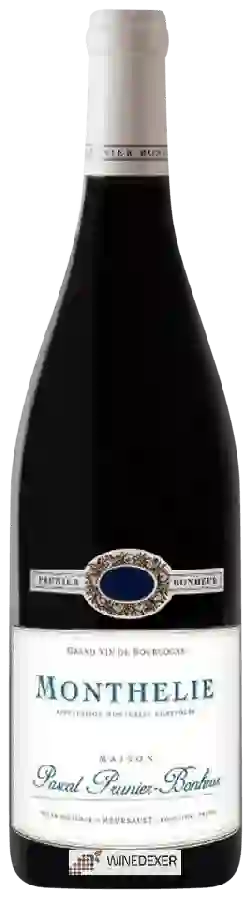
Winery Pascal Prunier-BonheurMonthélie
 White wine



In the mouth this white wine is a powerful.
This wine generally goes well with rich fish (salmon, tuna etc), shellfish or mild and soft cheese.

Taste structure of the Monthélie from the Winery Pascal Prunier-Bonheur
Light | Bold | |
Dry | Sweet | |
Soft | Acidic |
In the mouth the Monthélie of Winery Pascal Prunier-Bonheur in the region of Burgundy is a powerful.
Food and wine pairings with Monthélie
Pairings that work perfectly with Monthélie



Original food and wine pairings with Monthélie


The Monthélie of Winery Pascal Prunier-Bonheur matches generally quite well with dishes of pasta, rich fish (salmon, tuna etc) or shellfish such as recipes of chicken wok with chinese noodles, cod "bacalhau a gomes de sa or fish paella.
Details and technical informations about Winery Pascal Prunier-Bonheur's Monthélie.
Discover the grape variety: Chardonnay
Whites with many faces: mineral and taut at Chablis (lemon, green apple, flint), opulent and buttery at Meursault and Puligny-Montrachet (hazelnut, brioche, yellow fruits), tense and chalky in Champagne (Blanc de Blancs). Also vinified sparkling and widely exported (Sonoma, Margaret River, Casablanca). A Burgundian variety, a cross of Pinot Noir × Gouais Blanc, half-sibling of Aligoté.
Informations about the Winery Pascal Prunier-Bonheur
The Winery Pascal Prunier-Bonheur is one of of the world's great estates. It offers 32 wines for sale in the of Monthélie to come and discover on site or to buy online.

The wine region of Monthélie
Village at the heart of Côte de Beaune between Meursault and Volnay: Pinot Noir flagship red (~92%) — ruby robe with violet glints and harmonious and delicate profile with signature notes of cherry, raspberry, peony, spices and undergrowth in evolution. Racy Chardonnay flagship white (~8%) with hawthorn, citrus, reinette apple and vanilla touch, signature roundness-freshness balance. AOC (1937), 15 Premiers Crus, southeast marl-limestone, 250-300 m, aging 3-15 years.
The wine region of Burgundy
Absolute reference for great terroir wines: opulent, mineral Chardonnay in whites (chiselled Chablis, buttery Meursault, majestic Montrachet), fine and silky Pinot Noir in reds (full-bodied Gevrey, structured Pommard, delicate Volnay). Exceptional age-worthy wines with complex notes - red fruits, undergrowth, butter, hazelnut. Some lively Aligoté and light Gamay (Mâconnais). 29,500 ha, 84 tiered AOCs (Régionale, Village, 1er Cru, Grand Cru), 1,247 UNESCO Climats.
The word of the wine: Performance
Quantity of grapes harvested per hectare. In AOC, the average yield is limited on the proposal of the appellation syndicate, validated by the Inao. The use of high-performance plant material (especially clones) and better control of vine diseases have increased yields. This is not without consequences on the quality of the wines (dilution) and on the state of the market (too much wine). We must not over-simplify: low yields are not synonymous with quality, and it is often in years with generous harvests that we find the greatest vintages (1982 and 1986 in Bordeaux, 1996 in Champagne, 1990 and 2005 in Burgundy...).