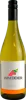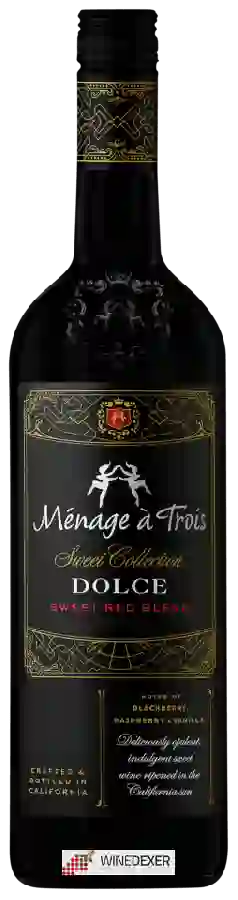
Winery Ménage à TroisSweet Collection Dolce Sweet Red Blend
 Sweet wine



This wine generally goes well with

Details and technical informations about Winery Ménage à Trois's Sweet Collection Dolce Sweet Red Blend.
Discover the grape variety: Lacrima
Supple and intensely aromatic reds with a deep ruby robe, melted tannins and an airy palate with preserved acidity, showing powerful signature aromas of rose, violet, red fruits (cherry, raspberry), gentle spices and Marchigian balsamic notes. Star of Lacrima di Morro d'Alba DOC, signing the floral and typified reds of the Italian Marche region. Native black Italian grape from the Marche, grown mainly around Morro d'Alba.
Last vintages of this wine
The best vintages of Sweet Collection Dolce Sweet Red Blend from Winery Ménage à Trois are 0
Informations about the Winery Ménage à Trois
The Winery Ménage à Trois is one of of the world's great estates. It offers 27 wines for sale in the of California to come and discover on site or to buy online.

The wine region of California
Powerful, sunny reds: dense Napa Cabernet Sauvignon (blackcurrant, chocolate, tobacco, ample tannins), spicy, jammy Zinfandel from the Sierra Foothills, silky red-fruited Pinot Noir on the cool coast (Sonoma, Russian River, Central Coast). Opulent, buttery Chardonnay, notes of yellow fruit and vanilla. Varied climate, from the hot interior to the Pacific-cooled coast. 80% of US production, 139 AVAs including Napa (1st AVA, 1981).
The word of the wine: Fees
This wine is characterized by a pleasant nervousness and an overall sensation of freshness on the palate, reinforced by minerality, a note of bitterness, a hint of CO2, and of course an appropriate serving temperature.