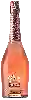
Winery Le Vigne di LuciaProsecco Extra Dry
 wine
wine
This wine generally goes well with
The Prosecco Extra Dry of the Winery Le Vigne di Lucia is in the top 0 of wines of Prosecco.
Details and technical informations about Winery Le Vigne di Lucia's Prosecco Extra Dry.
Discover the grape variety: Roussette d'Ayze
Roussette d'Ayze is one of the secondary grape varieties used in the production of Ayze wines. It is grown only in the Arve Valley, in the communes of Marignier, Ayze and Bonneville, covering a total area of approximately 22 hectares. If its grapes are white at the beginning, they gradually turn golden, until they are ripe. Despite the juicy pulp of the Ayze roussette, it is not sufficiently aromatic and the wine it produces is of average quality, which is why it is considered more effective in the production of sparkling wines. The cultivation is fruitful and somewhat rapid, provided of course that this variety is not exposed to grey rot or mildew.
Informations about the Winery Le Vigne di Lucia
The Winery Le Vigne di Lucia is one of of the world's greatest estates. It offers 3 wines for sale in the of Prosecco to come and discover on site or to buy online.

The wine region of Prosecco
The wine region of Prosecco is located in the region of Vénétie of Italy. We currently count 1461 estates and châteaux in the of Prosecco, producing 2419 different wines in conventional, organic and biodynamic agriculture. The wines of Prosecco go well with generally quite well with dishes .
The wine region of Veneto
Veneto is an important and growing wine region in northeastern Italy. Veneto is administratively Part of the Triveneto area, aLong with its smaller neighbors, Trentino-Alto Adige and Friuli-Venezia Giulia. In terms of geography, culture and wine styles, it represents a transition from the Alpine and Germanic-Slavic end of Italy to the warmer, drier, more Roman lands to the South. Veneto is slightly smaller than the other major Italian wine regions - Piedmont, Tuscany, Lombardy, Puglia and Sicily - but it produces more wine than any of them.
The word of the wine: Oenologist
Specialist in wine-making techniques. It is a profession and not a passion: one can be an oenophile without being an oenologist (and the opposite too!). Formerly attached to the Faculty of Pharmacy, oenology studies have become independent and have their own university course. Learning to make wine requires a good chemical background but also, increasingly, a good knowledge of the plant. Some oenologists work in laboratories (analysis). Others, the consulting oenologists, work directly in the properties.