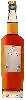
Winery l'EstanyGrande Réserve Rivesaltes Ambré Vin Doux Naturel
 Sweet wine
This wine generally goes well with
Details and technical informations about Winery l'Estany's Grande Réserve Rivesaltes Ambré Vin Doux Naturel.
Discover the grape variety: Canari
The Canary is rarely found in today's vineyards. Its origins are probably in the Pyrenees, precisely in the Ariège. Its repertoire of alternative appellations is vast. Boudalès from the Cévennes becomes folle noire in Fronton. It is also known as chalosse noire, ugne noire or canaril, and can be recognized by its early buds. The very productive vine shows remarkable vigour. Even the black rot does not get the better of this variety. The shoots are covered with foliage, the most exposed parts of which turn red in the autumn. When the grapes reach maturity, which occurs in the second late season, the Canari displays compact, section-shaped bunches of small to medium size. The fins are sometimes very crowded, gathering berries with characteristic colors. The bluish-black shell protects a very juicy flesh. A rather lightly coloured and ordinary wine emerges from the vinification of this variety.
Informations about the Winery l'Estany
The Winery l'Estany is one of of the world's greatest estates. It offers 2 wines for sale in the of Rivesaltes to come and discover on site or to buy online.

The wine region of Rivesaltes
Rivesaltes is an appellation for the historic Sweet wines of eastern Roussillon, in the DeepSouth of France. The natural sweet wines produced in this region have been revered since at least the 14th century. The technique used to make them is one of many techniques used for sweet wines. Unlike botrytized wines or ice wines, natural sweet wines are made by Mutage, a process that involves stopping the Fermentation of the must while a high level of natural sweetness remains.
The wine region of Languedoc-Roussillon
Languedoc (formerly Coteaux du Languedoc) is a key appellation used in the Languedoc-Roussillon wine region of southern France. It covers Dry table wines of all three colors (red, white and rosé) from the entire region, but leaves Sweet and Sparkling wines to other more specialized appellations. About 75% of all Languedoc wines are red, with the remaining 25% split roughly down the middle between whites and rosés. The appellation covers most of the Languedoc region and almost a third of all the vineyards in France.
The word of the wine: Amylic
Aroma reminiscent of banana, candy, and sometimes nail polish, particularly present in primeur wines. The amylic taste is reminiscent of the aromas of industrial confectionery and does not reflect a great expression of terroir.