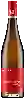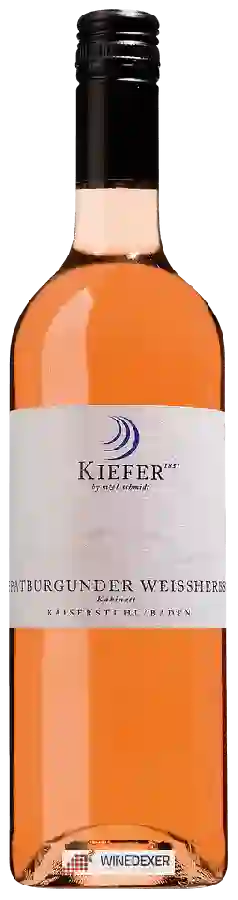
Winery KieferSpätburgunder Weissherbst Kabinett
 Pink wine


This wine generally goes well with vegetarian
Food and wine pairings with Spätburgunder Weissherbst Kabinett
Pairings that work perfectly with Spätburgunder Weissherbst Kabinett

Original food and wine pairings with Spätburgunder Weissherbst Kabinett
The Spätburgunder Weissherbst Kabinett of Winery Kiefer matches generally quite well with dishes of vegetarian such as recipes of light tuna-tomato quiche (without cream).
Details and technical informations about Winery Kiefer's Spätburgunder Weissherbst Kabinett.
Discover the grape variety: Etraire de l'Aduï
Would be finding its first origins in the valley of Isere, one would have indeed found it in the Mas de l'Aduï in Saint Ismier. We find a certain resemblance with the Persian. Today its multiplication in nurseries is very weak, registered however with the official Catalogue of the varieties of vine list A1 under the name of Etraire de la Dui.
Last vintages of this wine
The best vintages of Spätburgunder Weissherbst Kabinett from Winery Kiefer are 0
Informations about the Winery Kiefer
The Winery Kiefer is one of of the world's great estates. It offers 85 wines for sale in the of Baden to come and discover on site or to buy online.

The wine region of Baden
Baden is the southernmost of Germany's 13 official wine regions. It is also the warmest. Its relatively sunny, DryClimate permits the production of good-quality Spätburgunder (Pinot Noir) and ripe, relatively Full-bodied">Full-bodied examples of Grauburgunder (Pinot Gris) and Weissburgunder (Pinot Blanc). These are often made in oaked styles.
The word of the wine: Delicate
Said of a wine that is fine and subtle in the mouth.