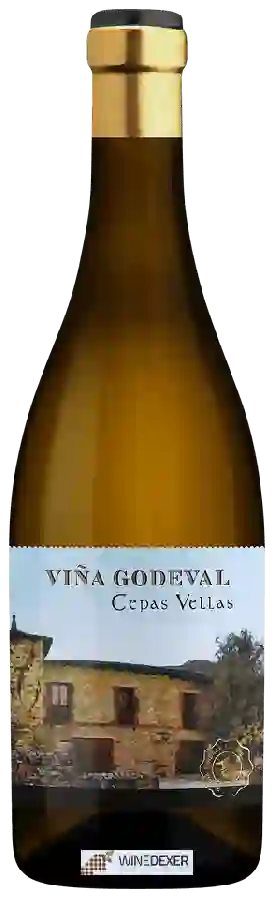
Winery GodevalCepas Vellas
 White wine


This wine generally goes well with
The Cepas Vellas of the Winery Godeval is in the top 10 of wines of Valdeorras.
Wine flavors and olphactive analysis






On the nose the Cepas Vellas of Winery Godeval in the region of Galice often reveals types of flavors of earth, microbio or vegetal and sometimes also flavors of oak, tree fruit or spices.
Details and technical informations about Winery Godeval's Cepas Vellas.
Discover the grape variety: Baco blanc
Interspecific crossing obtained in 1898 by François Baco (1865-1947) between the folle blanche and the noah, which it resembles somewhat. With the latter, Baco blanc is distinguished by a light beige felt under the leaf, whereas it is white for the noah. It is registered in the Official Catalogue of wine grape varieties list A1.
Last vintages of this wine

The best vintages of Cepas Vellas from Winery Godeval are 2015, 2017, 2016, 0 and 2014.
Informations about the Winery Godeval
The Winery Godeval is one of of the world's greatest estates. It offers 6 wines for sale in the of Valdeorras to come and discover on site or to buy online.

The wine region of Valdeorras
The wine region of Valdeorras is located in the region of Galice of Spain. Wineries and vineyards like the Domaine Rafael Palacios or the Domaine Rafael Palacios produce mainly wines white, red and sweet. The most planted grape varieties in the region of Valdeorras are Mencia, Albarino and Trousseau, they are then used in wines in blends or as a single variety. On the nose of Valdeorras often reveals types of flavors of pineapple, mango or slate and sometimes also flavors of black fruit, red fruit or watermelon.
The wine region of Galice
Galicia is one of the 17 first-level administrative regions (called comunidades autónomas) of Spain. It occupies the northwestern corner of the Iberian Peninsula, and is exposed on two sides to the Atlantic Ocean. To the South is Portugal, to the east Castilla y Leon. Viticulture has a Long tradition in Galicia, introduced to the region by the ancient Romans and continued by monks throughout the Middle Ages.
The word of the wine: Phenolic ripeness
A distinction is made between the ripeness of sugars and acids and the ripeness of tannins and other compounds such as anthocyanins and tannins, which will bring structure and colour. Grapes can be measured at 13° potential without having reached this phenolic maturity. Vinified at this stage, they will give hard, astringent wines, without charm.