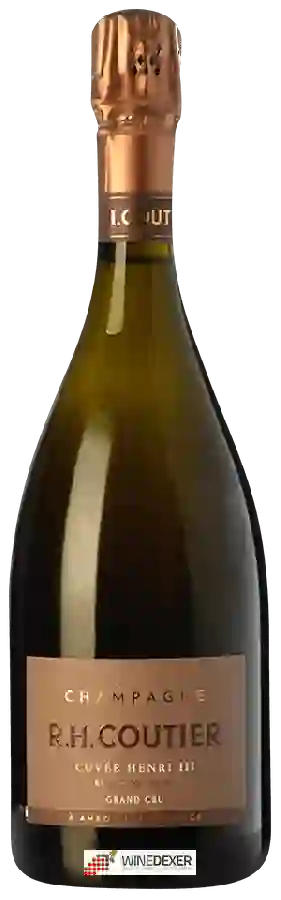
Winery R.H. CoutierCuvée Henri III Blanc de Noirs Brut Millésime Champagne Grand Cru
 Sparkling wine


In the mouth this sparkling wine is a powerful with a nice vivacity and a fine and pleasant bubble.
This wine generally goes well with pork, rich fish (salmon, tuna etc) or shellfish.
Taste structure of the Cuvée Henri III Blanc de Noirs Brut Millésime Champagne Grand Cru from the Winery R.H. Coutier
Light | Bold | |
Soft | Acidic | |
Gentle | Fizzy |
In the mouth the Cuvée Henri III Blanc de Noirs Brut Millésime Champagne Grand Cru of Winery R.H. Coutier in the region of Champagne is a powerful with a nice vivacity and a fine and pleasant bubble.
Wine flavors and olphactive analysis




On the nose the Cuvée Henri III Blanc de Noirs Brut Millésime Champagne Grand Cru of Winery R.H. Coutier in the region of Champagne often reveals types of flavors of apples, earthy or green apple and sometimes also flavors of pear, brioche or yeast.
Food and wine pairings with Cuvée Henri III Blanc de Noirs Brut Millésime Champagne Grand Cru
Pairings that work perfectly with Cuvée Henri III Blanc de Noirs Brut Millésime Champagne Grand Cru



Original food and wine pairings with Cuvée Henri III Blanc de Noirs Brut Millésime Champagne Grand Cru

The Cuvée Henri III Blanc de Noirs Brut Millésime Champagne Grand Cru of Winery R.H. Coutier matches generally quite well with dishes of pork, rich fish (salmon, tuna etc) or shellfish such as recipes of sauté of veal with olives (corsica), tuna and mozzarella pie or scallops on a bed of leeks.
Details and technical informations about Winery R.H. Coutier's Cuvée Henri III Blanc de Noirs Brut Millésime Champagne Grand Cru.
Discover the grape variety: Pinot noir
Pinot noir is an important red grape variety in Burgundy and Champagne, and its reputation is well known! Great wines such as the Domaine de la Romanée Conti elaborate their wines from this famous grape variety, and make it a great variety. When properly vinified, pinot noit produces red wines of great finesse, with a wide range of aromas depending on its advancement (fruit, undergrowth, leather). it is also the only red grape variety authorized in Alsace. Pinot Noir is not easily cultivated beyond our borders, although it has enjoyed some success in Oregon, the United States, Australia and New Zealand.
Last vintages of this wine

The best vintages of Cuvée Henri III Blanc de Noirs Brut Millésime Champagne Grand Cru from Winery R.H. Coutier are 2004, 2009, 2006, 2008 and 2005.
Informations about the Winery R.H. Coutier
The Winery R.H. Coutier is one of of the world's greatest estates. It offers 11 wines for sale in the of Champagne Grand Cru to come and discover on site or to buy online.

The wine region of Champagne Grand Cru
Champagne grand cru is a Sparkling white wine produced in the vineyards of the Champagne region of northeastern France and more specifically in the wine regions of the Montagne de Reims, the Vallée de la Marne, the Côte des Blancs, the Côte des Bar, the Côte de Sézanne and Vitry-le-François. Administratively, the Champagne grand cru can be produced in the departments of Marne, Aisne, Aube, Seine-et-Marne and Haute-Marne. Its vineyards benefit from a temperate-oceanic Climate with a continental influence and a Terroir made of limestone and marl soils. The Champagne Grand Cru wine can be made with the following main Grape varieties: Chardonnay B, Meunier N, Pinot N, Arbane B, Petit Meslier B, Pinot B.
The wine region of Champagne
Champagne is the name of the world's most famous Sparkling wine, the appellation under which it is sold and the French wine region from which it comes. Although it has been used to refer to sparkling wines around the world - a point of controversy and legal wrangling in recent decades - Champagne is a legally controlled and restricted name. See the labels of Champagne wines. The fame and success of Champagne is, of course, the product of many Complex factors.
The word of the wine: Cinsault
Cinsault is a southern black grape variety that can be found in the blends of most Mediterranean appellations, but most often as an accessory grape variety. It is undoubtedly most present in certain rosé wines (in Corbières, Côtes-de-Provence, etc.): it gives these wines highly appreciated aromas of strawberry, peach and raspberry. In vin de pays (IGP), it is often vinified on its own, usually as a rosé.