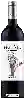
Domaine du Grand ChêneLe Canon Côtes du Roussillon
 wine
wine
This wine generally goes well with
The Le Canon Côtes du Roussillon of the Domaine du Grand Chêne is in the top 0 of wines of Côtes du Roussillon.
Details and technical informations about Domaine du Grand Chêne's Le Canon Côtes du Roussillon.
Discover the grape variety: Sylvaner
The sylvaner is grown mainly in Germany and Alsace. The buds are somewhat cottony and the young leaves are green. The same applies to the ribbed branches. Once mature, the dominant colour is golden-green and small elliptical berries with small to medium-sized bunches can be seen. The ripe fruit is then adorned by five-lobed leaves. This variety is susceptible to chlorosis, gray mold, powdery mildew and mildew. It is also sensitive to frost and wind because of its long branches. It can be grown in any kind of soil, although it prefers stony, sandy and light soils. It is indeed moderately acidic and offers a complex set of aromas such as bitter almond, fruity and floral background. The taste has an excellent mixture of honey and candied or dried fruits.
Informations about the Domaine du Grand Chêne
The Domaine du Grand Chêne is one of of the world's greatest estates. It offers 6 wines for sale in the of Côtes du Roussillon to come and discover on site or to buy online.

The wine region of Côtes du Roussillon
Côtes du Roussillon is an appellation contrôlée for red, white and rosé wines from the Roussillon wine region in southern France. It covers the eastern half of the administrative district of the Pyrénées-Orientales, on the eastern edge of the Pyrenees. The western half of the Pyrenees-Orientales is simply too mountainous for effective viticulture. In the Côtes du Roussillon wine-growing area is the Aspres sub-region.
The wine region of Languedoc-Roussillon
Languedoc (formerly Coteaux du Languedoc) is a key appellation used in the Languedoc-Roussillon wine region of southern France. It covers Dry table wines of all three colors (red, white and rosé) from the entire region, but leaves Sweet and Sparkling wines to other more specialized appellations. About 75% of all Languedoc wines are red, with the remaining 25% split roughly down the middle between whites and rosés. The appellation covers most of the Languedoc region and almost a third of all the vineyards in France.
The word of the wine: Deposit
Solid particles that can naturally coat the bottom of a bottle of wine. It is rather a guarantee that the wine has not been mistreated: in fact, to avoid the natural deposit, rather violent processes of filtration or cold passage (- 7 or - 8 °C) are used in order to precipitate the tartar (the small white crystals that some people confuse with crystallized sugar: just taste to dissuade you from it)