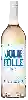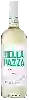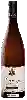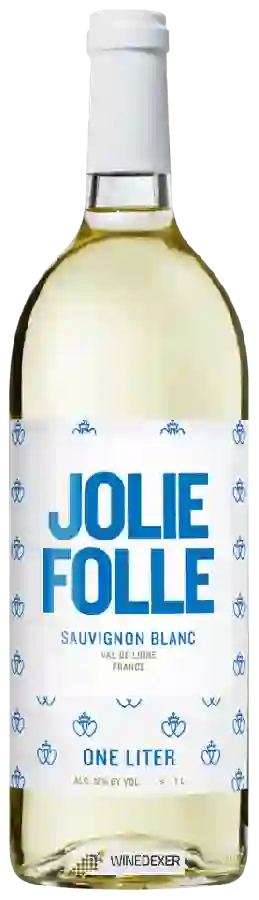
Winery Crazy Beautiful WinesJolie Folle Sauvignon blanc
 White wine



This wine generally goes well with vegetarian, rich fish (salmon, tuna etc) or shellfish.
Food and wine pairings with Jolie Folle Sauvignon blanc
Pairings that work perfectly with Jolie Folle Sauvignon blanc



Original food and wine pairings with Jolie Folle Sauvignon blanc
The Jolie Folle Sauvignon blanc of Winery Crazy Beautiful Wines matches generally quite well with dishes such as recipes .
Details and technical informations about Winery Crazy Beautiful Wines's Jolie Folle Sauvignon blanc.
Discover the grape variety: Molinara
Its origin is not very precise, it has been cultivated for a very long time in northern Italy, ... in France it is almost unknown. It should not be confused with the Spanish variety molinera gorda.
Last vintages of this wine
The best vintages of Jolie Folle Sauvignon blanc from Winery Crazy Beautiful Wines are 2016, 0
Informations about the Winery Crazy Beautiful Wines
The Winery Crazy Beautiful Wines is one of of the world's greatest estates. It offers 9 wines for sale in the of Loire Valley to come and discover on site or to buy online.

The wine region of Loire Valley
The Loire Valley is a key wine region in western France. It follows the course of the Loire River on its Long journey through the heart of France, from the inland hills of the Auvergne to the plains of the French Atlantic coast near Nantes (Muscadet country). Important in terms of quantity and quality, the region produces large quantities (about 4 million h/l each year) of everyday wines, as well as some of France's greatest wines. Diversity is another of the region's major assets; the styles of wine produced here range from the light, tangy Muscadet to the Sweet, honeyed Bonnezeaux, the Sparkling whites of Vouvray and the juicy, Tannic reds of Chinon and Saumur.
The word of the wine: Deposit
Solid particles that can naturally coat the bottom of a bottle of wine. It is rather a guarantee that the wine has not been mistreated: in fact, to avoid the natural deposit, rather violent processes of filtration or cold passage (- 7 or - 8 °C) are used in order to precipitate the tartar (the small white crystals that some people confuse with crystallized sugar: just taste to dissuade you from it)