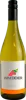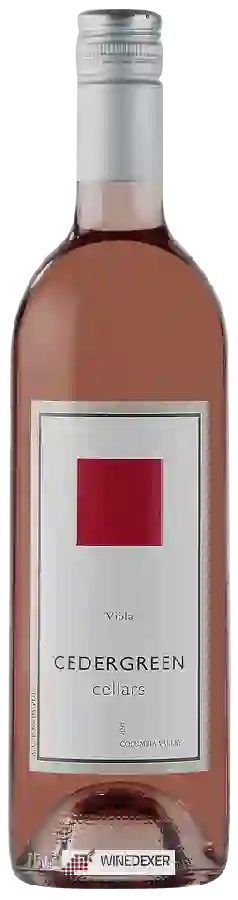
Winery Cedergreen CellarsViola Rosé
 Pink wine



This wine generally goes well with

Wine flavors and olphactive analysis

On the nose the Viola Rosé of Winery Cedergreen Cellars in the region of Washington often reveals types of flavors of red fruit.
Details and technical informations about Winery Cedergreen Cellars's Viola Rosé.
Discover the grape variety: Othello
Colourful reds with the characteristic foxy taste of Vitis labrusca, a sustained ruby robe, soft tannins and an airy palate, with typical labruscoid aromas (wild strawberry, candy). In France, it is among the six hybrids banned since 1935 (with Clinton, Herbemont, Isabelle, Jacquez, Noah), still found in heritage trellises. French black hybrid obtained by Henri Bouschet (folle blanche × clinton).
Last vintages of this wine
The best vintages of Viola Rosé from Winery Cedergreen Cellars are 0
Informations about the Winery Cedergreen Cellars
The Winery Cedergreen Cellars is one of of the world's greatest estates. It offers 9 wines for sale in the of Columbia Valley to come and discover on site or to buy online.

The wine region of Columbia Valley
Cradle of Washington State's great reds. Dense, structured Cabernet Sauvignon (blackcurrant, blackberry, graphite, firm tannins), round velvety Merlot, signature Syrah with peppery notes, black olive and deep black fruit. Also precise whites: balanced Chardonnay, taut fruity Riesling with peach notes. Semi-desert vineyard of 24,300 ha sheltered by the Cascades, loess soils over basalt, strong temperature swings.
The wine region of Washington
2nd US producer by volume, on the arid, sunny Columbia Valley. Star Cabernet Sauvignon (~60% of reds): powerful and structured with signature notes of blackcurrant, blackberry, cedar, dry herbs and graphite, firm tannins. Fleshy, peppery Syrah (black fruits, smoked meat). Round, fruity Merlot, historic mineral Riesling (dry and off-dry), precise Chardonnay and ample Sémillon.
The word of the wine: Serious
A Bordeaux term for small pebbles from the Pyrenees, eroded, rounded and transported by the Garonne to Aquitaine. They are mainly found on the left bank in the area.... known as the Graves, and further downstream in the Médoc. By extension, gravel is found in other regions, brought by other rivers or even glaciers.