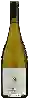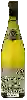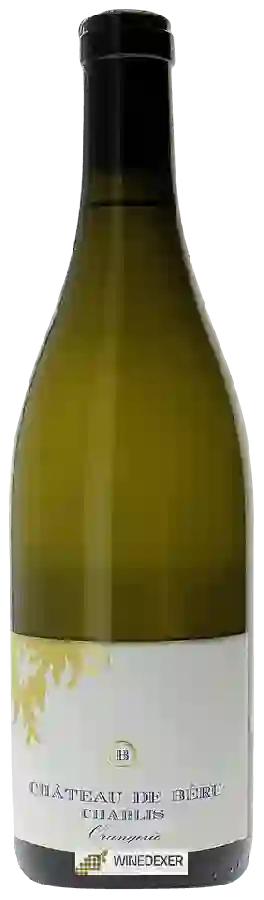
Château de BéruOrangerie Chablis
 White wine


In the mouth this white wine is a with a nice freshness.
This wine generally goes well with pork, rich fish (salmon, tuna etc) or shellfish.

Taste structure of the Orangerie Chablis from the Château de Béru
Light | Bold | |
Dry | Sweet | |
Soft | Acidic |
In the mouth the Orangerie Chablis of Château de Béru in the region of Burgundy is a with a nice freshness.
Wine flavors and olphactive analysis



On the nose the Orangerie Chablis of Château de Béru in the region of Burgundy often reveals types of flavors of citrus, minerality or earth and sometimes also flavors of microbio, oak or tree fruit.
Food and wine pairings with Orangerie Chablis
Pairings that work perfectly with Orangerie Chablis



Original food and wine pairings with Orangerie Chablis

The Orangerie Chablis of Château de Béru matches generally quite well with dishes of pork, rich fish (salmon, tuna etc) or shellfish such as recipes of braised (green) cabbage, baked salmon mediterranean style or fish and seafood gratin.
Details and technical informations about Château de Béru's Orangerie Chablis.
Discover the grape variety: Chardonnay
Whites with many faces: mineral and taut at Chablis (lemon, green apple, flint), opulent and buttery at Meursault and Puligny-Montrachet (hazelnut, brioche, yellow fruits), tense and chalky in Champagne (Blanc de Blancs). Also vinified sparkling and widely exported (Sonoma, Margaret River, Casablanca). A Burgundian variety, a cross of Pinot Noir × Gouais Blanc, half-sibling of Aligoté.
Last vintages of this wine
The best vintages of Orangerie Chablis from Château de Béru are 2017, 2014, 2015
Informations about the Château de Béru
The Château de Béru is one of of the world's greatest estates. It offers 11 wines for sale in the of Chablis to come and discover on site or to buy online.

The wine region of Chablis
World reference for mineral Chardonnay. Straight, taut whites with signature notes of lime, green apple, white flowers, flint and iodine, a saline finish driven by Kimmeridgian marls full of oyster fossils. The purest expression of the grape, little oak. Hierarchy: lively Petit Chablis, fresh Chablis, more complex Premier Cru (Montée de Tonnerre, Vaillons), 7 age-worthy Grands Crus (Les Clos, Valmur, Bougros…).
The wine region of Burgundy
Absolute reference for great terroir wines: opulent, mineral Chardonnay in whites (chiselled Chablis, buttery Meursault, majestic Montrachet), fine and silky Pinot Noir in reds (full-bodied Gevrey, structured Pommard, delicate Volnay). Exceptional age-worthy wines with complex notes - red fruits, undergrowth, butter, hazelnut. Some lively Aligoté and light Gamay (Mâconnais). 29,500 ha, 84 tiered AOCs (Régionale, Village, 1er Cru, Grand Cru), 1,247 UNESCO Climats.
The word of the wine: Malolactic fermentation
Called second fermentation or malo for short. It is the degradation (under the effect of bacteria) of the malic acid naturally present in the wine into milder, less aggressive lactic acid. Some producers or wineries refuse this operation by "blocking the malo" (by cold and adding SO2) to keep a maximum of acidity which carries the aromas and accentuates the sensation of freshness.