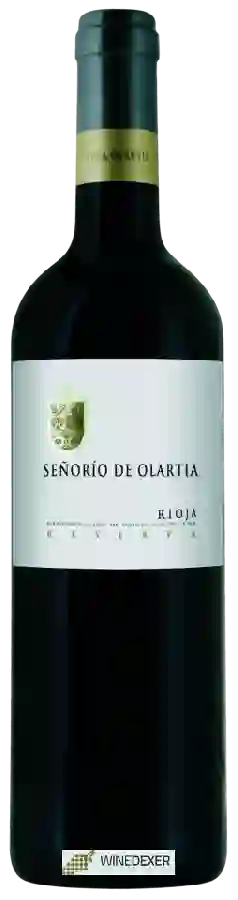
Winery Vinícola de RodeznoSeñorio de Olartia Rioja Reserva
 Red wine



In the mouth this red wine is a powerful with a nice balance between acidity and tannins.
This wine generally goes well with poultry, beef or veal.
Taste structure of the Señorio de Olartia Rioja Reserva from the Winery Vinícola de Rodezno
Light | Bold | |
Smooth | Tannic | |
Dry | Sweet | |
Soft | Acidic |
In the mouth the Señorio de Olartia Rioja Reserva of Winery Vinícola de Rodezno in the region of Rioja is a powerful with a nice balance between acidity and tannins.
Food and wine pairings with Señorio de Olartia Rioja Reserva
Pairings that work perfectly with Señorio de Olartia Rioja Reserva



Original food and wine pairings with Señorio de Olartia Rioja Reserva

The Señorio de Olartia Rioja Reserva of Winery Vinícola de Rodezno matches generally quite well with dishes of beef, lamb or veal such as recipes of pot-au-feu, shoulder of lamb stuffed with cognac or sliced endives with ham.
Details and technical informations about Winery Vinícola de Rodezno's Señorio de Olartia Rioja Reserva.
Discover the grape variety: Queen
Intraspecific crossing obtained in 1954 in the United States by Professor Harold P. Olmo of the University of Davis (California) by crossing the Hamburg Muscat with the Sultana.
Last vintages of this wine
The best vintages of Señorio de Olartia Rioja Reserva from Winery Vinícola de Rodezno are 2004, 2007, 0
Informations about the Winery Vinícola de Rodezno
The Winery Vinícola de Rodezno is one of of the world's greatest estates. It offers 1 wines for sale in the of Rioja to come and discover on site or to buy online.

The wine region of Rioja
Rioja, in northern Spain, is best known for its berry-flavored, barrel-aged red wines made from Tempranillo and Garnacha. It is probably the leading wine region in Spain. It is certainly the most famous, rivaling only Jerez. The Vineyards follow the course of the Ebro for a hundred kilometres between the towns of Haro and Alfaro.
The word of the wine: Aging
Period during which a wine is kept in a cellar where it goes through different phases of evolution of its aromatic range and a maturation of its constituents (evolution of the colour, refining of the tannins, harmonization of the different flavours, etc.). The wine evolves better and less quickly in large containers, whereas it deteriorates prematurely in half-bottles.