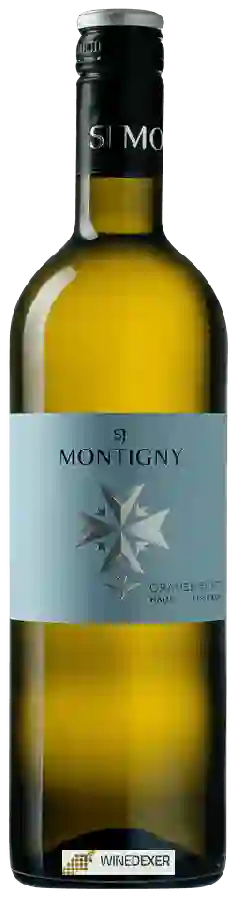
Winery S.J. MontignyGrauer Burgunder Trocken
 White wine


In the mouth this white wine is a powerful.
This wine generally goes well with pork, cured meat or mushrooms.
Taste structure of the Grauer Burgunder Trocken from the Winery S.J. Montigny
Light | Bold | |
Dry | Sweet | |
Soft | Acidic |
In the mouth the Grauer Burgunder Trocken of Winery S.J. Montigny in the region of Nahe is a powerful.
Food and wine pairings with Grauer Burgunder Trocken
Pairings that work perfectly with Grauer Burgunder Trocken


Original food and wine pairings with Grauer Burgunder Trocken

The Grauer Burgunder Trocken of Winery S.J. Montigny matches generally quite well with dishes of pork, spicy food or mushrooms such as recipes of tartiflette (from a real savoyard), fish with madras curry and coconut milk or chicken parmentier.
Details and technical informations about Winery S.J. Montigny's Grauer Burgunder Trocken.
Discover the grape variety: Abondance
A very old grape variety that was once grown in Savoie and more generally in the Isère Valley, but has now almost disappeared from the vineyards. It should not be confused with Abundant which is a white grape variety formerly cultivated in eastern France.
Last vintages of this wine
The best vintages of Grauer Burgunder Trocken from Winery S.J. Montigny are 0, 2015
Informations about the Winery S.J. Montigny
The Winery S.J. Montigny is one of of the world's great estates. It offers 54 wines for sale in the of Nahe to come and discover on site or to buy online.

The wine region of Nahe
Nahe is one of the smaller German wine regions, named after the Nahe river which joins the Rhein at Rheinhessen/bingen">Bingen. The viticultural carea here is characterised by dramatic topography with steep slopes and craggy outcrops of metamorphic rock. Like most of the regions on or near the Rhine, its most prestigious wines are made from Riesling. There are around 4,000 hectares (10,000 acres) of Vineyards, spread across seven Grosslagen (wine districts) and over 300 Einzellagen (individual vineyard sites).
The word of the wine: Size (champagne)
Juices that flow from the press after the cuvée, at the second pressing. Less fine, often more vegetal, it is mainly used to make the first price champagnes.