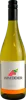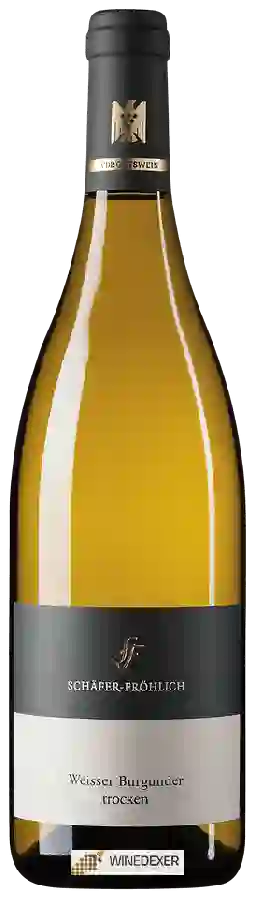
Winery Schäfer-FröhlichWeisser Burgunder Trocken
 White wine



In the mouth this white wine is a powerful with a nice freshness.
This wine generally goes well with rich fish (salmon, tuna etc), shellfish or mild and soft cheese.
Taste structure of the Weisser Burgunder Trocken from the Winery Schäfer-Fröhlich
Light | Bold | |
Dry | Sweet | |
Soft | Acidic |
In the mouth the Weisser Burgunder Trocken of Winery Schäfer-Fröhlich in the region of Nahe is a powerful with a nice freshness.
Wine flavors and olphactive analysis




On the nose the Weisser Burgunder Trocken of Winery Schäfer-Fröhlich in the region of Nahe often reveals types of flavors of earth, microbio or vegetal and sometimes also flavors of tree fruit, spices or citrus fruit.
Food and wine pairings with Weisser Burgunder Trocken
Pairings that work perfectly with Weisser Burgunder Trocken



Original food and wine pairings with Weisser Burgunder Trocken

The Weisser Burgunder Trocken of Winery Schäfer-Fröhlich matches generally quite well with dishes of rich fish (salmon, tuna etc), shellfish or mild and soft cheese such as recipes of pasta with tuna and cream, thai shrimp sauce or toasted bagel with smoked salmon.
Details and technical informations about Winery Schäfer-Fröhlich's Weisser Burgunder Trocken.
Discover the grape variety: Big Muscat seedless
Variety of Argentinean origin.
Last vintages of this wine
The best vintages of Weisser Burgunder Trocken from Winery Schäfer-Fröhlich are 2014, 2013, 2018, 2012 and 0.
Informations about the Winery Schäfer-Fröhlich
The Winery Schäfer-Fröhlich is one of of the world's great estates. It offers 60 wines for sale in the of Nahe to come and discover on site or to buy online.

The wine region of Nahe
Nahe is one of the smaller German wine regions, named after the Nahe river which joins the Rhein at Rheinhessen/bingen">Bingen. The viticultural carea here is characterised by dramatic topography with steep slopes and craggy outcrops of metamorphic rock. Like most of the regions on or near the Rhine, its most prestigious wines are made from Riesling. There are around 4,000 hectares (10,000 acres) of Vineyards, spread across seven Grosslagen (wine districts) and over 300 Einzellagen (individual vineyard sites).
The word of the wine: Acescence
An alteration in wine also known as pitting (hence the expression piqué wine), due to the presence of acetic acid and ethyl acetate, and characterized by a vinegar-like odor.