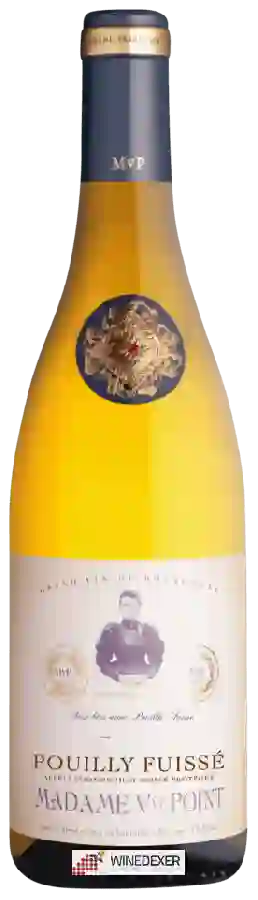
Winery Madame Veuve PointPouilly-Fuissé
 White wine


In the mouth this white wine is a with a nice freshness.
This wine generally goes well with vegetarian, cured meat or pasta.

Taste structure of the Pouilly-Fuissé from the Winery Madame Veuve Point
Light | Bold | |
Dry | Sweet | |
Soft | Acidic |
In the mouth the Pouilly-Fuissé of Winery Madame Veuve Point in the region of Burgundy is a with a nice freshness.
Wine flavors and olphactive analysis


On the nose the Pouilly-Fuissé of Winery Madame Veuve Point in the region of Burgundy often reveals types of flavors of tree fruit.
Food and wine pairings with Pouilly-Fuissé
Pairings that work perfectly with Pouilly-Fuissé



Original food and wine pairings with Pouilly-Fuissé
The Pouilly-Fuissé of Winery Madame Veuve Point matches generally quite well with dishes of pasta, vegetarian or cured meat such as recipes of spaghetti with beef balls, goat cheese and bacon quiche or beef carrots.
Details and technical informations about Winery Madame Veuve Point's Pouilly-Fuissé.
Discover the grape variety: Grassen
Structured, fresh reds with a deep purple colour, firm tannins and an ample palate with fresh acidity, signature aromas of red fruits (cherry, raspberry) and alpine spices. Moderate ageing potential. Preserved for its heritage value, it belongs to the rare indigenous varieties of Valais and occasionally features in artisanal high-altitude cuvées. Indigenous Swiss black variety from Valais, grown in tiny quantities.
Last vintages of this wine
The best vintages of Pouilly-Fuissé from Winery Madame Veuve Point are 2016
Informations about the Winery Madame Veuve Point
The Winery Madame Veuve Point is one of of the world's great estates. It offers 38 wines for sale in the of Pouilly-Fuissé to come and discover on site or to buy online.

The wine region of Pouilly-Fuissé
Emblematic great white of the Mâconnais (southern Burgundy): signature Chardonnay reigns exclusively in whites — pale to green-gold with emerald glints, round and fleshy with citrus (lemon, grapefruit, pineapple), peach, almond, hazelnut, breadcrumb, brioche, honey and a flinty mineral touch, a richness-freshness balance without excess nervousness. AOC (1936), 758 ha across 4 villages (Vergisson, Solutré, Fuissé, Chaintré) below the eponymous rocks, clays and limestones.
The wine region of Burgundy
Absolute reference for great terroir wines: opulent, mineral Chardonnay in whites (chiselled Chablis, buttery Meursault, majestic Montrachet), fine and silky Pinot Noir in reds (full-bodied Gevrey, structured Pommard, delicate Volnay). Exceptional age-worthy wines with complex notes - red fruits, undergrowth, butter, hazelnut. Some lively Aligoté and light Gamay (Mâconnais). 29,500 ha, 84 tiered AOCs (Régionale, Village, 1er Cru, Grand Cru), 1,247 UNESCO Climats.
The word of the wine: Skinny
Thin and lacking in substance in the mouth.