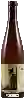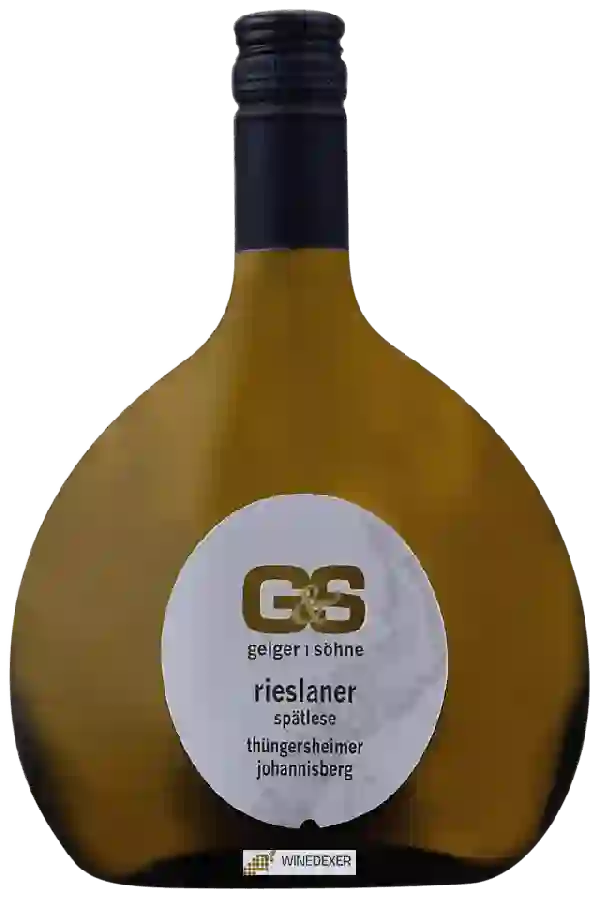
Weingut Geiger & SöhneRieslaner Spätlese Thüngersheimer Johannisberg
 White wine
In the mouth this white wine is a with a nice freshness.
This wine generally goes well with pork, vegetarian or poultry.

Taste structure of the Rieslaner Spätlese Thüngersheimer Johannisberg from the Weingut Geiger & Söhne
Light | Bold | |
Dry | Sweet | |
Soft | Acidic |
In the mouth the Rieslaner Spätlese Thüngersheimer Johannisberg of Weingut Geiger & Söhne in the region of Franken is a with a nice freshness.
Food and wine pairings with Rieslaner Spätlese Thüngersheimer Johannisberg
Pairings that work perfectly with Rieslaner Spätlese Thüngersheimer Johannisberg



Original food and wine pairings with Rieslaner Spätlese Thüngersheimer Johannisberg


The Rieslaner Spätlese Thüngersheimer Johannisberg of Weingut Geiger & Söhne matches generally quite well with dishes of veal, pork or vegetarian such as recipes of beef bourguignon with cookéo, pork roll with tomato sauce or quiche without pastry, courgette and blue cheese.
Details and technical informations about Weingut Geiger & Söhne's Rieslaner Spätlese Thüngersheimer Johannisberg.
Discover the grape variety: Jurançon
Light, fruity reds with a pale ruby colour, soft tannins, and an airy palate with moderate acidity, offering red-fruit aromas and herbaceous notes. Productive. Today marginal, surviving in a few heritage parcels in Béarn and Bigorre. Not to be confused with the Jurançon AOC (white wines). A synonym of Jurançon noir, a French black variety native to the South-West.
Informations about the Weingut Geiger & Söhne
The Weingut Geiger & Söhne is one of of the world's great estates. It offers 74 wines for sale in the of Franken to come and discover on site or to buy online.

The wine region of Franken
Homeland of German Silvaner: dry, straight, mineral and lively whites with notes of green apple, citrus, fresh herbs and a saline touch, planted here for over 350 years (1,500 ha, a quarter of the vineyard). Also supple, floral Müller-Thurgau, taut Riesling, aromatic Bacchus. Some discreet reds (Spätburgunder). 6,040 ha in Bavaria along the Main around Würzburg, red sandstone and shell-limestone soils.
The word of the wine: Rebêche (champagne)
Must obtained in excess of the 2 550 litres authorised for a weight of 4 000 kilos of grapes. The first 2 050 litres constitute the cuvée and the next 500 litres the taille. The rebêche represents 1 to 3 % of the total volume and must be distilled or used to make ratafia.