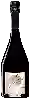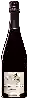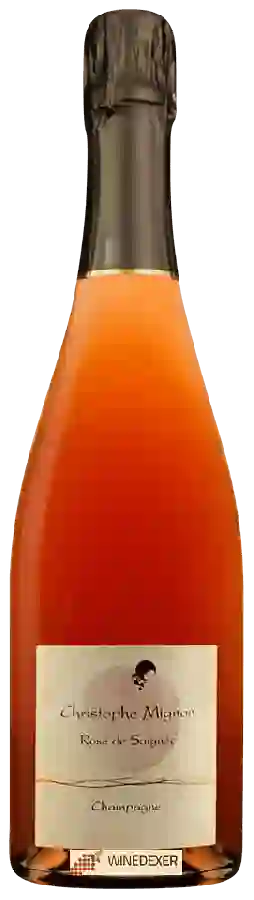
Winery Christophe MignonRosé de Saignée Champagne
 Sparkling wine



In the mouth this sparkling wine is a powerful with a nice vivacity and a fine and pleasant bubble.
This wine generally goes well with pork, rich fish (salmon, tuna etc) or shellfish.
Taste structure of the Rosé de Saignée Champagne from the Winery Christophe Mignon
Light | Bold | |
Soft | Acidic | |
Gentle | Fizzy |
In the mouth the Rosé de Saignée Champagne of Winery Christophe Mignon in the region of Champagne is a powerful with a nice vivacity and a fine and pleasant bubble.
Food and wine pairings with Rosé de Saignée Champagne
Pairings that work perfectly with Rosé de Saignée Champagne



Original food and wine pairings with Rosé de Saignée Champagne

The Rosé de Saignée Champagne of Winery Christophe Mignon matches generally quite well with dishes of pork, rich fish (salmon, tuna etc) or shellfish such as recipes of rabbit with cider and mushrooms, smoked salmon and herb sandwich cakes or blanquette of the sea.
Details and technical informations about Winery Christophe Mignon's Rosé de Saignée Champagne.
Discover the grape variety: Muscat bleu
An interspecific cross between 15-6 Garnier (villard noir or 18315 Seyve-Villard x Müller-Thurgau) and perle noire or 20347 Seyve-Villard (panse de Provence x 12358 Seyve-Villard), obtained in Switzerland in the 1930s by a nurseryman named Garnier. Muscat Bleu can be found in Germany, Switzerland, Belgium, etc. In France, it is practically unknown. It is listed in the Official Catalogue of Vine Varieties, list A2.
Informations about the Winery Christophe Mignon
The Winery Christophe Mignon is one of of the world's greatest estates. It offers 16 wines for sale in the of Champagne to come and discover on site or to buy online.

The wine region of Champagne
Champagne is the name of the world's most famous Sparkling wine, the appellation under which it is sold and the French wine region from which it comes. Although it has been used to refer to sparkling wines around the world - a point of controversy and legal wrangling in recent decades - Champagne is a legally controlled and restricted name. See the labels of Champagne wines. The fame and success of Champagne is, of course, the product of many Complex factors.
The word of the wine: Roussette
See highness.