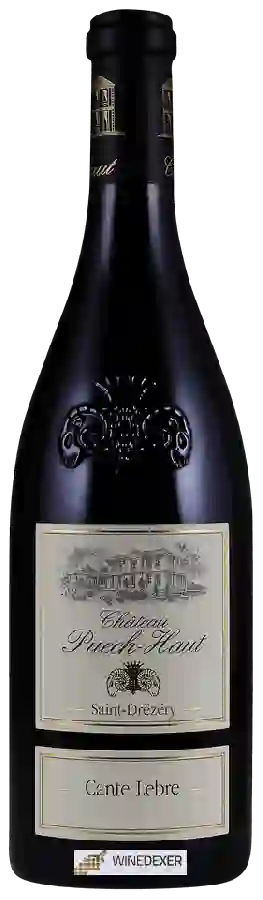
Château Puech-HautCante Lebre Saint-Drézéry
 Red wine


In the mouth this red wine is a powerful with a nice balance between acidity and tannins.
This wine generally goes well with beef, veal or pasta.

Taste structure of the Cante Lebre Saint-Drézéry from the Château Puech-Haut
Light | Bold | |
Smooth | Tannic | |
Dry | Sweet | |
Soft | Acidic |
In the mouth the Cante Lebre Saint-Drézéry of Château Puech-Haut in the region of Languedoc-Roussillon is a powerful with a nice balance between acidity and tannins.
Wine flavors and olphactive analysis



On the nose the Cante Lebre Saint-Drézéry of Château Puech-Haut in the region of Languedoc-Roussillon often reveals types of flavors of earth, oak or spices and sometimes also flavors of red fruit, black fruit.
Food and wine pairings with Cante Lebre Saint-Drézéry
Pairings that work perfectly with Cante Lebre Saint-Drézéry



Original food and wine pairings with Cante Lebre Saint-Drézéry
The Cante Lebre Saint-Drézéry of Château Puech-Haut matches generally quite well with dishes of beef, pasta or veal such as recipes of celine's version of moussaka (5th meeting), lasagna bolognese or veal with chestnut and pietra (corsican beer).
Details and technical informations about Château Puech-Haut's Cante Lebre Saint-Drézéry.
Discover the grape variety: Garonnet
Colourful, structured reds with a sustained purple robe, firm tannins and an ample palate with preserved acidity. Signature aromas of black fruits (blackcurrant, blackberry) and spice. Productive. Grown in small quantities in south-west France for IGPs, blended into modern southern assemblages. A French black grape obtained in 1959 by crossing Morrastel-Bouschet × Cot.
Last vintages of this wine
The best vintages of Cante Lebre Saint-Drézéry from Château Puech-Haut are 2014, 2009
Informations about the Château Puech-Haut
The Château Puech-Haut is one of of the world's great estates. It offers 53 wines for sale in the of Saint-Drézéry to come and discover on site or to buy online.

The wine region of Saint-Drézéry
Languedoc AOC 25 km northeast of Montpellier (hills at 70–160 m, calcareous soils with sandstone, marls, gravelly clays and characteristic rounded pebbles, low-rainfall Mediterranean): Grenache, Syrah and Mourvèdre are the signature reds in blends (≥70%) — full-bodied and concentrated with ripe black fruits, liquorice and spice notes, tannin structure softened by limestone. Carignan and Cinsault as complements, in the Grès de Montpellier sector.
The wine region of Languedoc-Roussillon
Largest single French vineyard, dominated by sunny, generous reds. Spicy Syrah, candied Grenache (ripe fruit, garrigue), structured Carignan, deep Mourvèdre, supple Cinsault. Stars: structured Corbières, Minervois, Faugères, Saint-Chinian; round Côtes-du-Roussillon. Legendary vins doux naturels: Banyuls and Maury (fortified Grenache) with notes of cocoa, fig, prune.
The word of the wine: Secondary aromas
Aromas resulting from the fermentation and maturation of the wine before bottling. The aging in barrels modifies considerably the texture and the flavours of the wine.