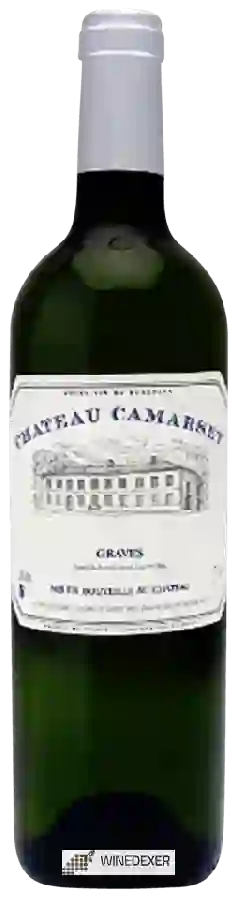
Château CamarsetGraves Blanc
 wine
wine
This wine generally goes well with
The Graves Blanc of the Château Camarset is in the top 0 of wines of Graves.
Details and technical informations about Château Camarset's Graves Blanc.
Discover the grape variety: Divico
Interspecific cross between gamaret and bronner obtained in 1997 by Jean-Laurent Spring at the Agroscope Research Station in Pully (Switzerland). It should be noted that the divona is issued from the same cross.
Informations about the Château Camarset
The Château Camarset is one of of the world's greatest estates. It offers 2 wines for sale in the of Graves to come and discover on site or to buy online.

The wine region of Graves
Graves is a wine region on the left bank of the Bordeaux region of France, characterized by the gravel soils that give it its name. Unique among the sub-regions of Bordeaux, Graves is equally respected for its red and white wines. The AOC Graves, which covers both red and white wines, is the catch-all appellation of the district. A typical Graves red is based on the classic Bordeaux grapes, Cabernet Sauvignon and Merlot, with Cabernet Franc, Malbec and Petit Verdot sometimes in a supporting role.
The wine region of Bordeaux
Bordeaux, in southwestern France, is one of the most famous, prestigious and prolific wine regions in the world. The majority of Bordeaux wines (nearly 90% of the production Volume) are the Dry, medium and Full-bodied red Bordeaux blends for which it is famous. The finest (and most expensive) are the wines of the great châteaux of Haut-Médoc and the right bank appellations of Saint-Émilion and Pomerol. The former focuses (at the highest level) on Cabernet Sauvignon, the latter on Merlot.
The word of the wine: Shipping (liquor)
In champagne and wines made according to the traditional method, wine is added before corking to fill the void in the bottle created by disgorging. This added wine is often sweetened by sugar incorporated in variable proportions according to the style of wine sought (see dosage). Syn.: liqueur de dosage.