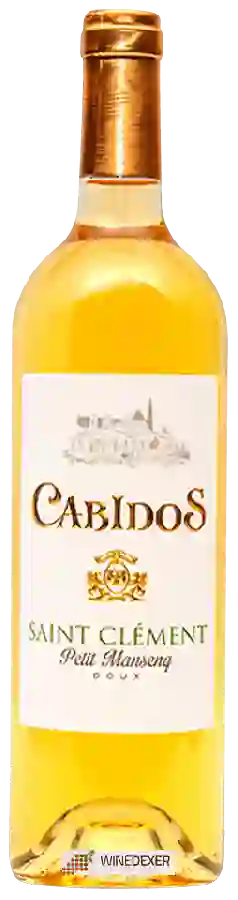
Winery CabidosCuvée Saint Clément Petit Manseng Doux
 Sweet wine


This wine generally goes well with
The Cuvée Saint Clément Petit Manseng Doux of the Winery Cabidos is in the top 80 of wines of Comté Tolosan.

Wine flavors and olphactive analysis




On the nose the Cuvée Saint Clément Petit Manseng Doux of Winery Cabidos in the region of Comté Tolosan often reveals types of flavors of pineapple, tropical or lemon and sometimes also flavors of orange, honey or earth.
Details and technical informations about Winery Cabidos's Cuvée Saint Clément Petit Manseng Doux.
Discover the grape variety: Petit Manseng
Exceptional sweet wines obtained by on-vine drying, with an unctuous mouth balanced by cutting acidity, featuring intense aromas of candied pineapple, mango, candied citrus, dried apricot, honey, dried fruits and sweet spice notes. Very high ageing potential. Star of Jurançon moelleux AOC and Pacherenc du Vic-Bilh AOC, also made as ambitious dry wines. Very late-ripening native grape of Béarn (South-West France).
Last vintages of this wine

The best vintages of Cuvée Saint Clément Petit Manseng Doux from Winery Cabidos are 2012, 2011, 2014, 2010
Informations about the Winery Cabidos
The Winery Cabidos is one of of the world's greatest estates. It offers 17 wines for sale in the of Comté Tolosan to come and discover on site or to buy online.

The wine region of Comté Tolosan
IGP covering all of southwest France across 12 departments, a broad and accessible palette. On the Garonne right bank, supple reds dominate: signature Merlot with signature notes of plum, ripe cherry, cocoa and a herbaceous touch, round tannins. Firm Cabernet, spicy Syrah, tannic local Tannat. Left bank for whites: vivid Colombard and Gros Manseng (citrus, grapefruit, exotic fruits), aromatic Sauvignon.
The word of the wine: Presses
The juice that results from pressing the grapes after fermentation. At the end of the maceration, the vats are emptied, the first juice obtained is called the free-run wine and the marc remaining at the bottom of the vat is then pressed to give the press wine. We say more quickly "the presses". Their quality varies according to the vintage and the maceration. A too vigorous extraction releases the tannins of pips and the wine of press can then prove to be very astringent. Often the winemaker raises it separately, deciding later whether or not to incorporate it totally or partially into the grand vin.