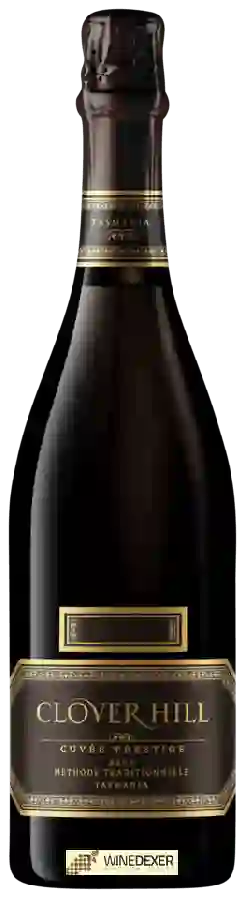
Winery Clover HillCuvée Prestige
 wine
wine
This wine generally goes well with
The Cuvée Prestige of the Winery Clover Hill is in the top 0 of wines of Tasmanie.
Details and technical informations about Winery Clover Hill's Cuvée Prestige.
Discover the grape variety: Bianca
Complex interspecific crossing between 12375 Seyve-Villard (2 Eger) and Bouvier - a variety of Austrian origin - obtained in 1963 and in Hungary by Csizmazia Jozsef and Bereznai Laszlo. It should be noted that Bianca, a monogenic variety, which is nevertheless resistant to certain cryptogamic diseases, was "bypassed" in 2010 by a less resistant strain of mildew, which was also the case for Regent. It can be found in the United States, Serbia, Hungary, Austria, Italy, Switzerland, ... almost unknown in France. In these countries, it is certainly the most cultivated as a wine grape but it can also be found on the markets.
Last vintages of this wine


The best vintages of Cuvée Prestige from Winery Clover Hill are 0
Informations about the Winery Clover Hill
The Winery Clover Hill is one of of the world's greatest estates. It offers 7 wines for sale in the of Tasmanie to come and discover on site or to buy online.

The wine region of Tasmanie
Tasmania is the island state of the island continent and the southernmost state of Australia. It Lies 240 kilometres (150 miles) off the coast of Victoria">Victoria, across Bass Strait - a relatively shallow channel that separates the Great Australian Bight from the Tasman Sea. As in the Yarra Valley and Mornington Peninsula, across Bass Strait in Victoria, the main grape varieties are Pinot noir and Chardonnay, and all three regions are renowned for their Sparkling wines. In general, however, Tasmania's choice of grape varieties is closer to New Zealand's than Australia's, reflecting the cool maritime Climate.
The word of the wine: Oxidative (breeding)
A method of ageing which aims to give the wine certain aromas of evolution (dried fruit, bitter orange, coffee, rancio, etc.) by exposing it to the air; it is then matured either in barrels, demi-muids or unoaked casks, sometimes stored in the open air, or in barrels exposed to the sun and to temperature variations. This type of maturation characterizes certain natural sweet wines, ports and other liqueur wines.